The half treble crochet sits between the short double crochet and the taller treble. It is quick to work, makes a soft and slightly squishy fabric, and is the go-to stitch for hats, blankets and baby items. This tutorial shows you how to make a UK half treble crochet (htr), how to keep your edges straight, and three textures you can make with it.
UK and US names
- UK half treble crochet (htr) = US half double crochet (hdc)
It is the same stitch with a different name. If you are following a US pattern that says “hdc”, this is the stitch you need.
What you need
- A smooth DK yarn in a light colour.
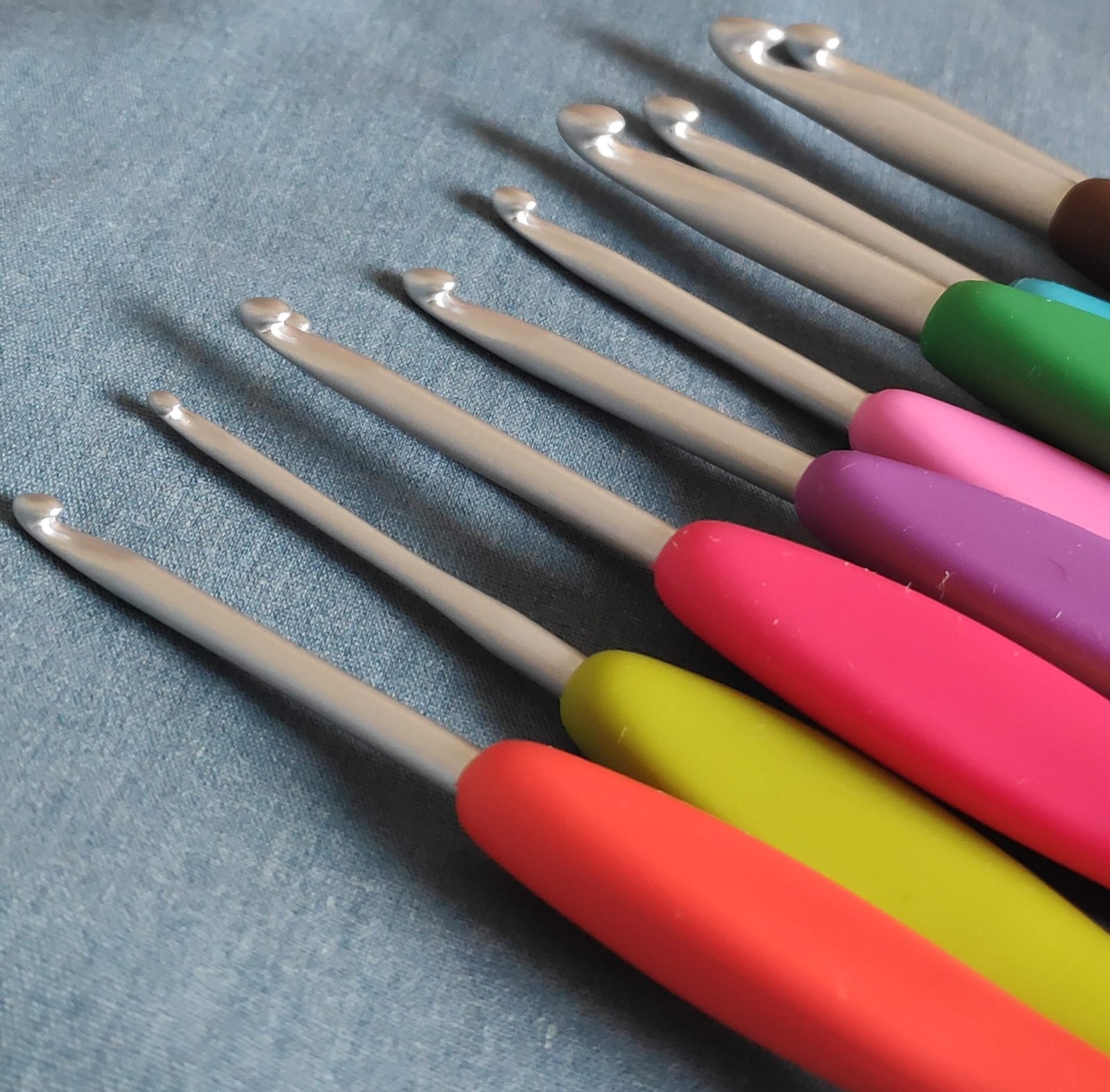
- A 4mm (UK 8 / US G-6) crochet hook.
How to make a half treble crochet (UK)
Make a foundation chain of 16 ch to practise.
- Yarn round hook. Wrap the yarn over the hook from back to front, so you have 2 loops on the hook.
- Insert the hook. On the first row, insert into the 3rd chain from the hook. On later rows, insert under both top loops of the next stitch.
- Pull up a loop. Yarn round hook and pull through the stitch. You now have 3 loops on the hook.
- Pull through all 3. Yarn round hook and pull through all 3 loops in one movement. One half treble is done.
The difference from a treble is the last step: instead of two pairs of “pull through 2”, you pull through all three loops at once. That is why the stitch is shorter and quicker.
Practice swatch
Row 1: 1 htr in 3rd ch from hook (the skipped chains do not count as a stitch), 1 htr in each ch to the end. Turn. (14 htr)
Row 2: 2 ch (does not count as a st), 1 htr in each st across. Turn. (14 htr)
Repeat Row 2. Count your stitches at the end of each row to make sure you still have 14.
Turning chains for half treble
A half treble is about two chains tall, so rows start with 2 ch. Patterns handle this in two ways:
- 2 ch does not count (the most common modern method): work your first htr into the first stitch of the row. This gives the neatest edge.
- 2 ch counts as 1 htr: skip the first stitch and work the last htr into the top of the turning chain.
Check which one your pattern uses. Mixing them up is the main reason edges slope or rows grow.
Finding the “third loop”
Half trebles have a special feature: behind the usual two top loops, there is a horizontal bar on the back of each stitch, often called the third loop or camel stitch loop. Working into this bar instead of the top loops pushes both top loops forward and creates a pretty knit-look ridge on the front of your work. It is popular for hat brims, cuffs and blanket borders.
Three textures to try
1. Back loop half treble (ribbing)
Work every htr into the back loop only. Rows of this stitch make a stretchy ribbed fabric, perfect for hat brims and the cuffs on our baby booties.
2. Camel stitch
Work every htr into the third loop on the back of the stitch below. The front looks like a row of knit stitches.
3. Half treble in the spaces
Work each htr into the gap between two stitches of the row below rather than into the top loops. This gives a dense, woven-looking fabric that is very warm, ideal for scarves.
Common problems
Pulling through 3 loops is hard
Your loops are too tight. Lift the loop in step 3 up a little, and make sure the yarn is sitting on the wide part of the hook (the shaft), not the narrow throat.
My edges look uneven
Try the “2 ch does not count” method and place a marker in the first stitch of every row so you do not miss it.
There is a gap after the turning chain
Work the turning chain a little more tightly, or replace it with a “chainless starting half treble” once you are comfortable.
Quick reference
- Abbreviation: htr (UK) / hdc (US)
- Height: about 2 chains
- Turning chain: 2 ch
- First row: start in the 3rd ch from the hook
- Best for: hats, blankets, baby items, ribbing