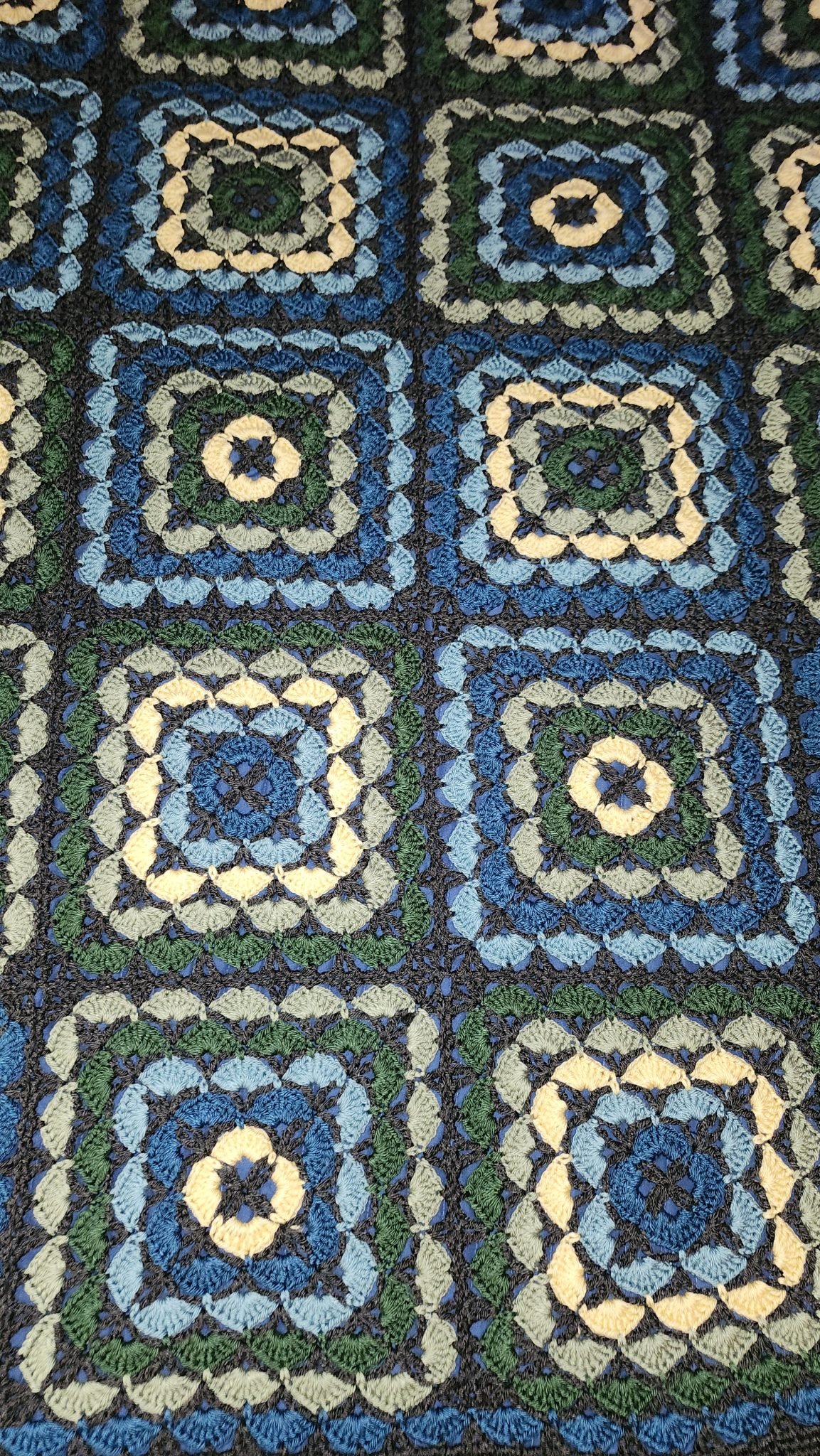
Few projects are as comforting as a granny stripe blanket growing across your lap on a dark autumn evening. There is no complicated counting once the first row is set up: every row is simply clusters of three trebles worked into the gaps of the row below. That rhythm is what makes it the perfect first blanket, and a lovely “telly project” for experienced crocheters too.
This pattern is written in UK crochet terms. If you usually follow American patterns, remember that a UK treble (tr) is the same stitch as a US double crochet (dc). There is a full conversion chart further up the page if you need it.
What you will make
- Finished size: about 95cm wide x 130cm long, a generous sofa throw or lap blanket.
- Look: soft, gently textured stripes in four colours, with a neat double crochet border.
- Skill level: beginner. You need to know how to make a chain, a slip stitch, double crochet and treble crochet.
Materials
- Yarn: about 2,200m of DK (double knitting) acrylic or acrylic blend. That is roughly 8 x 100g balls: 2 balls each of four colours. A soft palette such as cream, sage, dusty pink and oatmeal works beautifully.
- Hook: 4mm (UK 8 / US G-6), plus a 4.5mm hook for the foundation chain if you tend to chain tightly.
- A large-eyed tapestry needle and scissors.
- Optional: stitch markers to mark the first stitch of a row while you learn.
Tension: 4 groups of 3 trebles measure about 10cm across, worked in pattern with a 4mm hook. Tension is not critical for a blanket, but a much tighter or looser tension will change the finished size and the amount of yarn you need.
Abbreviations (UK terms)
- ch: chain
- ss: slip stitch
- dc: double crochet (US single crochet)
- tr: treble crochet (US double crochet)
- sp: space, here the gap between two groups of trebles
- st(s): stitch(es)
Pattern notes
- The foundation chain is a multiple of 3, plus 1. To make the blanket wider or narrower, add or remove chains in threes.
- The 3 chains at the start of each row count as 1 treble.
- The pattern alternates between two rows: Row A starts and ends with a full space, Row B starts and ends with a half group of 2 trebles. This keeps the side edges straight.
- Change colour at the end of a row: work the last stitch until 2 loops remain on the hook, then pull the new colour through. Leave 15cm tails to weave in.
Instructions
Foundation
Using colour 1, make 115 ch. Use the larger hook for the chain if your foundation edges tend to pull in.
Set-up row
Row 1 (right side): 1 tr in 4th ch from hook (the skipped chains count as 1 tr), *skip 2 ch, 3 tr in next ch*; repeat from * to the last 3 ch, skip 2 ch, 2 tr in last ch. Turn. (36 groups of 3 tr, with a half group of 2 tr at each end)
The two-row repeat
Row 2 (Row A): 3 ch (counts as 1 tr), 3 tr in each sp between groups across the row, ending with 3 tr in the last sp, 1 tr in the top of the turning chain. Turn. (37 groups of 3 tr, plus 1 tr at each end)
Row 3 (Row B): 3 ch (counts as 1 tr), 1 tr in the first st, 3 tr in each sp between groups across, 2 tr in the top of the turning chain. Turn. (36 groups of 3 tr, with a half group at each end)
Repeat Rows 2 and 3, changing colour every 2 rows in the order colour 1, 2, 3, 4. Continue until the blanket measures about 125cm, ending with a Row B. Fasten off.
Quick check: if your edges start to lean or your stitch count drifts, count the groups at the end of each row for the first 10 rows. After that, the pattern becomes second nature.
Border
Join colour 1 (or your favourite shade) in any corner with right side facing.
Round 1: 1 ch, then work dc evenly around all four sides: 1 dc in each st along the top and bottom edges, and 2 dc into the side of each treble row along the sides. Work (1 dc, 2 ch, 1 dc) into each corner. Join with a ss to the first dc.
Rounds 2 and 3: 1 ch, 1 dc in each dc around, working (1 dc, 2 ch, 1 dc) into each corner 2-ch sp. Join with a ss. Fasten off.
For a softer finish, work a final round of crab stitch (reverse double crochet), working dc from left to right instead of right to left.
Finishing
Weave in all tails along stitches of the same colour, splitting the yarn as you go so ends do not work loose in the wash. Lay the blanket flat on towels, mist it lightly with water and pat it into shape. Leave it to dry fully before folding. Acrylic does not need pinning, but a little steam (never touching the iron to the yarn) will relax wavy edges.
Customising your blanket
- Bigger sizes: for a single bed (about 140cm wide), start with 169 ch. For a double bed (about 200cm wide), start with 241 ch. Buy about 1.5 and 2.5 times the yarn respectively.
- Scrap version: change colour every row and use up odds and ends of DK. Keep one neutral colour for every fourth row so the blanket looks planned rather than random.
- Chunkier and faster: use aran yarn and a 5mm hook. Start with a smaller chain, as each group will be wider.
Yarn and care
A soft acrylic DK such as Stylecraft Special DK is the classic UK choice for blankets: hard-wearing, machine washable and affordable, with a huge colour range. Wool blends feel lovely but check the ball band before washing. Wash acrylic at 30 to 40 degrees on a gentle cycle and dry flat.