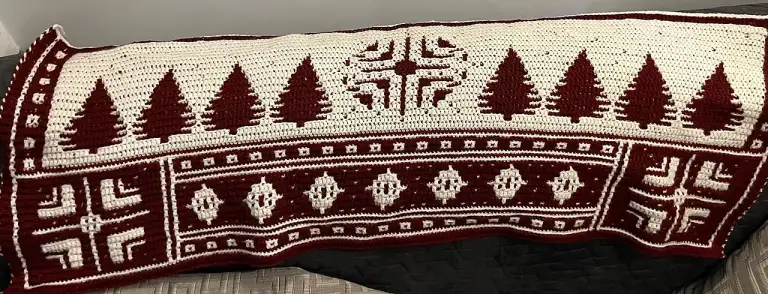
Mosaic crochet looks complicated, with bold geometric patterns that seem to need dozens of colour changes. The secret is that you only ever use one colour per row, and the pattern appears when some stitches are dropped down over the row below. It is one of the easiest ways to make striking colourwork, and it is perfect for blankets, cushions and bags.
This guide explains how mosaic crochet works, the difference between overlay and inset mosaic, how to read a chart, and gives you a free beginner mosaic crochet pattern in UK terms that you can practise on before moving to bigger designs.
Quick answer: Mosaic crochet is a colourwork technique where you work one colour per row in double crochet through the back loop, and drop long trebles into the front loop of the stitch two rows below to create the pattern. In overlay mosaic, every row is worked from the right side and fastened off at the end.
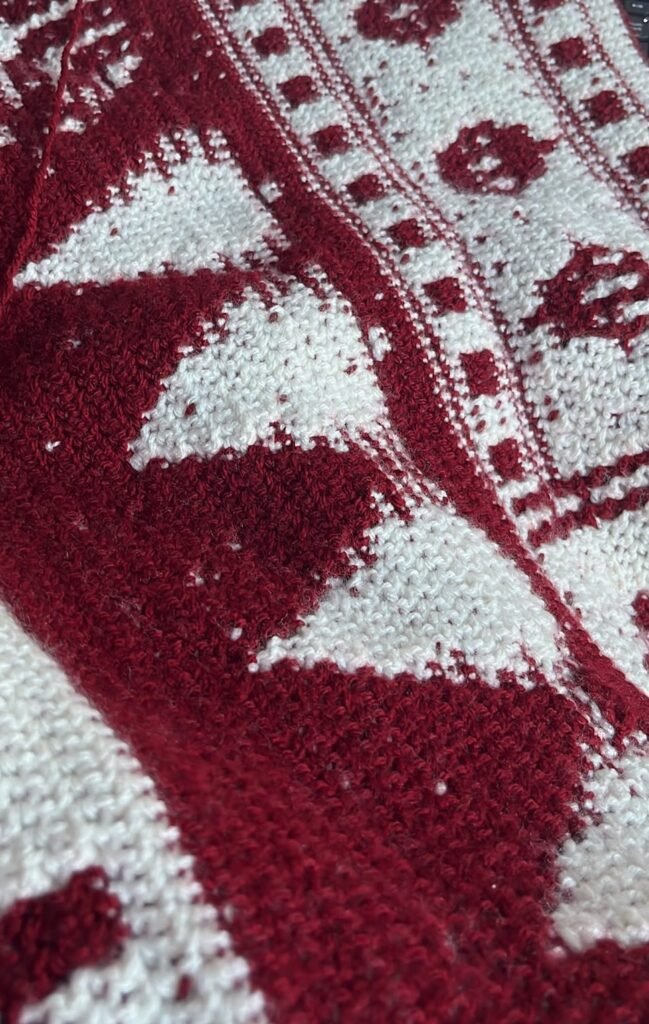
What is mosaic crochet?
Mosaic crochet is a colourwork technique worked in stripes. Each row uses a single colour, so there is no carrying yarn and no tangled bobbins. The pattern comes from long stitches that are worked down into a row of the same colour two rows below. Those long stitches cover the contrasting row in between, and together they build up squares, zigzags, crosses and diamonds.
Because you change colour every row, the fabric has a neat stripe on the back and a bold pattern on the front. It is thick, warm and holds its shape well, which is why overlay mosaic crochet is so popular for blankets and homeware.
Overlay vs inset mosaic crochet
| Overlay mosaic | Inset mosaic | |
|---|---|---|
| How it is worked | Every row is worked on the right side; you fasten off at the end of each row | Worked back and forth in pairs of rows, so fewer ends |
| Base stitch | Double crochet in the back loop only | Double crochet and chain spaces |
| Long stitch | Treble into the front loop two rows below | Treble into the skipped stitch two rows below |
| Result | Thick, textured, very crisp lines | Flatter, reversible-looking fabric |
| Best for | Beginners, cushions, blankets | Blankets where you want fewer ends |
This guide uses overlay mosaic crochet, because it is the easiest to learn and the pattern is very easy to see while you work.
What you need
- Yarn: two colours of DK yarn with strong contrast, such as navy and cream. Smooth acrylic or cotton shows the pattern best.
- Hook: 4mm (UK 8, US G-6).
- Extras: scissors, tapestry needle and a few stitch markers.
Avoid fluffy or variegated yarn for your first piece; the crisp lines of mosaic crochet are what make it look so good.
Abbreviations and stitches (UK terms)
- ch chain
- dc double crochet (US single crochet)
- dc BLO double crochet into the back loop only
- edge dc double crochet into both loops of the stitch (used for the first and last stitch of every row)
- tr FL2B treble (US double crochet) into the front loop of the stitch two rows below, keeping it in front of the row in between. Skip the stitch behind it in the current row.
That is the whole technique: back-loop double crochet, plus the occasional long treble dropped down in front. If you are new to these stitches, see our treble crochet tutorial first.
Free mosaic crochet pattern for beginners: interlocking columns
This practice piece makes a square about 15cm wide in DK yarn. You can use it as a coaster or sew several together. The pattern is worked over a multiple of 4 stitches plus 3.
Important: in overlay mosaic, every row is worked with the right side facing you. At the end of each row, fasten off and leave a 10cm tail. Join the next colour at the start of the same edge.
Foundation and set-up rows
Foundation (colour A): 24 ch.
Row 1 (A): 1 dc in the 2nd ch from the hook and in each ch to the end. Fasten off. (23 sts)
Row 2 (colour B): join B in the first stitch. Edge dc, dc BLO in each stitch to the last stitch, edge dc. Fasten off. (23 sts)
Row 3 (A): work as Row 2 in colour A. (23 sts)
Pattern rows
Row 4 (B): edge dc, [dc BLO in each of the next 3 sts, tr FL2B in the next st] 5 times, dc BLO in the next st, edge dc. Fasten off. (23 sts)
Row 5 (A): edge dc, [dc BLO in the next st, tr FL2B in the next st, dc BLO in each of the next 2 sts] 5 times, dc BLO in the next st, edge dc. Fasten off. (23 sts)
Repeat Rows 4 and 5 until the piece is square, about 30 rows in total, ending with a Row 5.
Last row (B): edge dc, dc BLO in each stitch to the last stitch, edge dc. Fasten off.
The long trebles in each row land between the trebles of the row before, so the two colours form interlocking vertical columns, as you can see in the chart below. Count to 23 stitches at the end of every row; if the count is right, the pattern will line up.


How to read a mosaic crochet chart
Most mosaic crochet patterns are written as charts, and they are easier to read than they look.
- Each row of squares is one row of crochet, read from right to left (left to right if you crochet left-handed), always from the right side.
- The colour on the edge of the row tells you which yarn to use for that row.
- A plain square in the row colour means dc BLO.
- A square marked with a dot or X means tr FL2B: a long treble dropped down two rows.
- Squares in the other colour are covered by long stitches from the row above, so you just work dc BLO there.
Before you start a new chart, highlight the row you are on, or use a ruler to cover the rows above it. Mosaic crochet is very rhythmic once you see the repeat.
What to do with all the ends
Because overlay mosaic is fastened off on every row, you will have two tails at the side of every row. There are three easy ways to deal with them:
- Fringe: tie the tails together in pairs and trim them evenly. This is quick and looks great on blankets and wall hangings.
- Enclose them in a border: work the border in dc, laying the tails along the edge and crocheting over them. Trim what is left. Our crochet blanket border guide has simple edging ideas.
- Sew them in: weave each tail into the stripe of the same colour on the back. It takes longer but gives the neatest finish.
Mosaic crochet project ideas
- Cushion: make a mosaic front and a plain back using the size chart in our crochet cushion cover patterns.
- Bag: two mosaic panels make a sturdy tote. See our crochet bag pattern for handles and lining tips.
- Blanket: join mosaic squares or work one big panel with a fringe on both sides.
- Coasters and placemats: the beginner pattern above is the perfect size for a coaster set.
- Christmas: use red and white for a festive cushion or table runner.

Common mosaic crochet mistakes and fixes
The long stitches pull the fabric
Make each treble long enough to reach two rows down without pulling. Lift the loop on your hook up to the height of the current row before you finish the stitch.
The pattern is in the wrong place
You probably missed skipping the stitch behind a long treble. Every tr FL2B replaces one stitch in the current row, so count stitches at the end of each row.
The edges are wavy
Always work the first and last stitch of each row as an edge dc in both loops, and keep your tension even when you join a new colour.
The fabric curls
Mosaic crochet is thick and can curl a little before blocking. Wet block it flat and let it dry fully; the border will also hold it straight.
Tips for neat mosaic crochet
- Choose colours with strong contrast; check them with a black and white photo on your phone.
- Use a slightly larger hook for the foundation chain so the first row is not tight.
- Keep both yarn balls on the same side of you, as every row starts at the same edge.
- Place a marker at the start of each pattern repeat on wide pieces.
Ready to try mosaic crochet?
Pick two contrasting colours of DK yarn and make the 23-stitch beginner square. Once you have done a few pattern rows, the rhythm of dc BLO and dropped trebles clicks into place, and you will be ready for bigger mosaic crochet charts, cushions and blankets.
Frequently asked questions about mosaic crochet
Is mosaic crochet good for beginners?
Yes. You only need double crochet in the back loop and one long treble stitch, and you use one colour per row, so there is no complicated colour carrying.
What is the difference between overlay and inset mosaic crochet?
Overlay mosaic is worked on the right side only, with trebles dropped in front of the row below, giving a thick textured fabric. Inset mosaic is worked back and forth with chain spaces, giving a flatter fabric with fewer ends.
Why do I fasten off every row in mosaic crochet?
In overlay mosaic, every row is worked from the right side so the long stitches always sit on the front. Fastening off lets you start each row at the same edge.
What yarn is best for mosaic crochet?
A smooth DK yarn in two strongly contrasting colours. Cotton and acrylic both work well; avoid fluffy or variegated yarn for your first project.
Is this mosaic crochet pattern in UK or US terms?
It is written in UK terms. In US terms, dc is single crochet (sc) and tr is double crochet (dc).