Few projects are as comforting as a granny stripe blanket growing across your lap on a dark autumn evening. There is no complicated counting once the first row is set up: every row is simply clusters of three trebles worked into the gaps of the row below. That rhythm is what makes it the perfect first blanket, and a lovely ‘telly project’ for experienced crocheters too.
At a glance: Yarn and hook: DK yarn and a 4mm (UK 8) hook (US G-6). Time: 15 to 20 hours. Terms: UK, with US conversions.
This free granny stripe blanket pattern is written in UK crochet terms. If you usually follow American patterns, remember that a UK treble (tr) is the same stitch as a US double crochet (dc). Our guide to UK vs US crochet terms has a full conversion chart if you need it.
Below you will find everything you need: materials, three sizes, the full pattern, a simple border, colour ideas, troubleshooting tips and answers to common questions.
Why a granny stripe blanket is a great first blanket
The granny stripe takes everything people love about granny squares and removes the fiddly parts. There are no squares to join, no corners to turn until the border, and fewer ends than a square-by-square blanket.
- Easy to remember: after the set-up row you only work two rows, over and over.
- Easy to fix: because each cluster sits in a gap, a missed group is easy to spot and correct.
- Easy to resize: add or remove chains in threes to change the width, and keep going until it is long enough.
- Easy on the eye: the open texture shows off colour beautifully, so even a simple palette looks lovely.
A granny stripe blanket also drapes well. The gaps between clusters let the fabric bend and fold, so it feels soft over your knees rather than stiff like a blanket made in a solid stitch.
What you will make
- Finished size: about 95cm wide x 130cm long, a generous sofa throw or lap blanket.
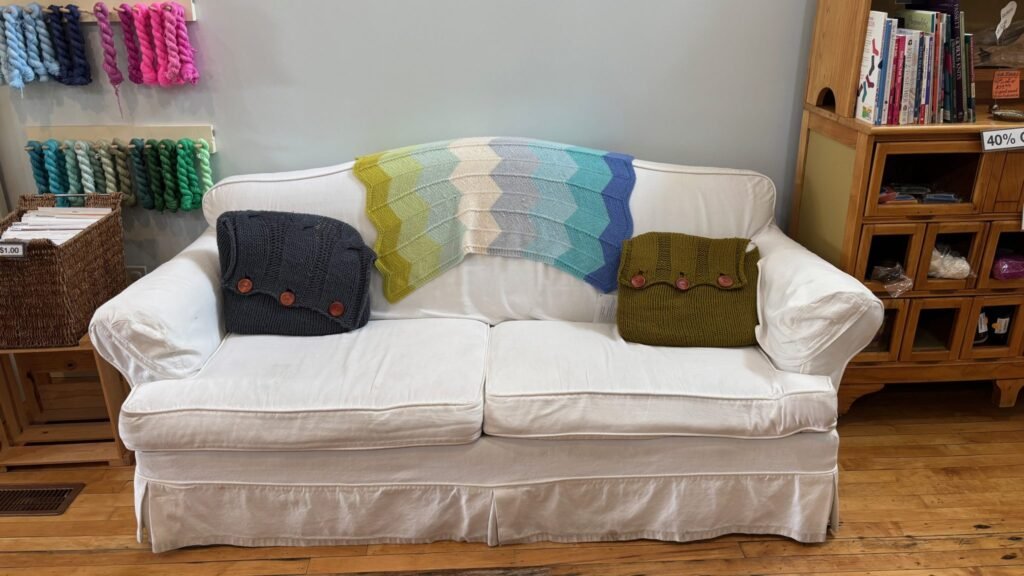
- Look: soft, gently textured stripes in four colours, with a neat double crochet border.
- Skill level: beginner. You need to know how to make a chain, a slip stitch, double crochet and treble crochet.
Materials
- Yarn: about 2,200m of DK (double knitting) acrylic or acrylic blend. That is roughly 8 x 100g balls: 2 balls each of four colours. A soft palette such as cream, sage, dusty pink and oatmeal works beautifully.
- Hook: 4mm (UK 8 / US G-6), plus a 4.5mm hook for the foundation chain if you tend to chain tightly.
- A large-eyed tapestry needle and scissors.
- Optional: stitch markers to mark the first stitch of a row while you learn.
Tension: 4 groups of 3 trebles measure about 10cm across, worked in pattern with a 4mm hook. Tension is not critical for a blanket, but a much tighter or looser tension will change the finished size and the amount of yarn you need.
If you are swapping yarns, the Craft Yarn Council yarn weight system explains how DK, aran and other weights compare. For a granny stripe blanket, stay with DK unless you are happy to adjust the chain length and hook size.
Granny stripe blanket sizes at a glance
This granny stripe blanket pattern works for any width that is a multiple of 3 plus 1. Here are the three sizes we suggest:
| Size | Foundation chain | Approx width | Yarn guide |
|---|---|---|---|
| Lap or sofa throw | 115 ch | 95cm | About 2,200m of DK |
| Single bed | 169 ch | 140cm | About 1.5 times the lap amount |
| Double bed | 241 ch | 200cm | About 2.5 times the lap amount |
The stitch counts in the pattern below are for the lap size. For the larger sizes the method is identical: you simply have more groups in each row. Work to the length you want, ending with a Row B.
For a bed blanket, measure the mattress and decide how far you want the blanket to hang over each side. Add that overhang to the width before you choose your chain.
Abbreviations (UK terms)
- ch: chain
- ss: slip stitch
- dc: double crochet (US single crochet)
- tr: treble crochet (US double crochet)
- sp: space, here the gap between two groups of trebles
- st(s): stitch(es)
Pattern notes
- The foundation chain is a multiple of 3, plus 1. To make the blanket wider or narrower, add or remove chains in threes.
- The 3 chains at the start of each row count as 1 treble.
- The pattern alternates between two rows: Row A starts and ends with a full space, Row B starts and ends with a half group of 2 trebles. This keeps the side edges straight.
- Change colour at the end of a row: work the last stitch until 2 loops remain on the hook, then pull the new colour through. Leave 15cm tails to weave in.
How to crochet the granny stripe blanket
Foundation
Using colour 1, make 115 ch. Use the larger hook for the chain if your foundation edges tend to pull in.
Set-up row
Row 1 (right side): 1 tr in 4th ch from hook (the skipped chains count as 1 tr), *skip 2 ch, 3 tr in next ch*; repeat from * to the last 3 ch, skip 2 ch, 2 tr in last ch. Turn. (36 groups of 3 tr, with a half group of 2 tr at each end)
The two-row repeat
Row 2 (Row A): 3 ch (counts as 1 tr), 3 tr in each sp between groups across the row, ending with 3 tr in the last sp, 1 tr in the top of the turning chain. Turn. (37 groups of 3 tr, plus 1 tr at each end)
Row 3 (Row B): 3 ch (counts as 1 tr), 1 tr in the first st, 3 tr in each sp between groups across, 2 tr in the top of the turning chain. Turn. (36 groups of 3 tr, with a half group at each end)
Repeat Rows 2 and 3, changing colour every 2 rows in the order colour 1, 2, 3, 4. Continue until the blanket measures about 125cm, ending with a Row B. Fasten off.
Quick check: if your edges start to lean or your stitch count drifts, count the groups at the end of each row for the first 10 rows. After that, the pattern becomes second nature.
Choosing colours for your granny stripe blanket
Colour is where your granny stripe blanket really becomes your own. Because each stripe is only two rows deep, the colours sit close together and blend from a distance.
- Soft and calm: cream, sage, dusty pink and oatmeal, as in the materials list, give a gentle, modern look.
- Bright and cheerful: pick four strong colours and add a white or cream stripe between each one to keep them fresh.
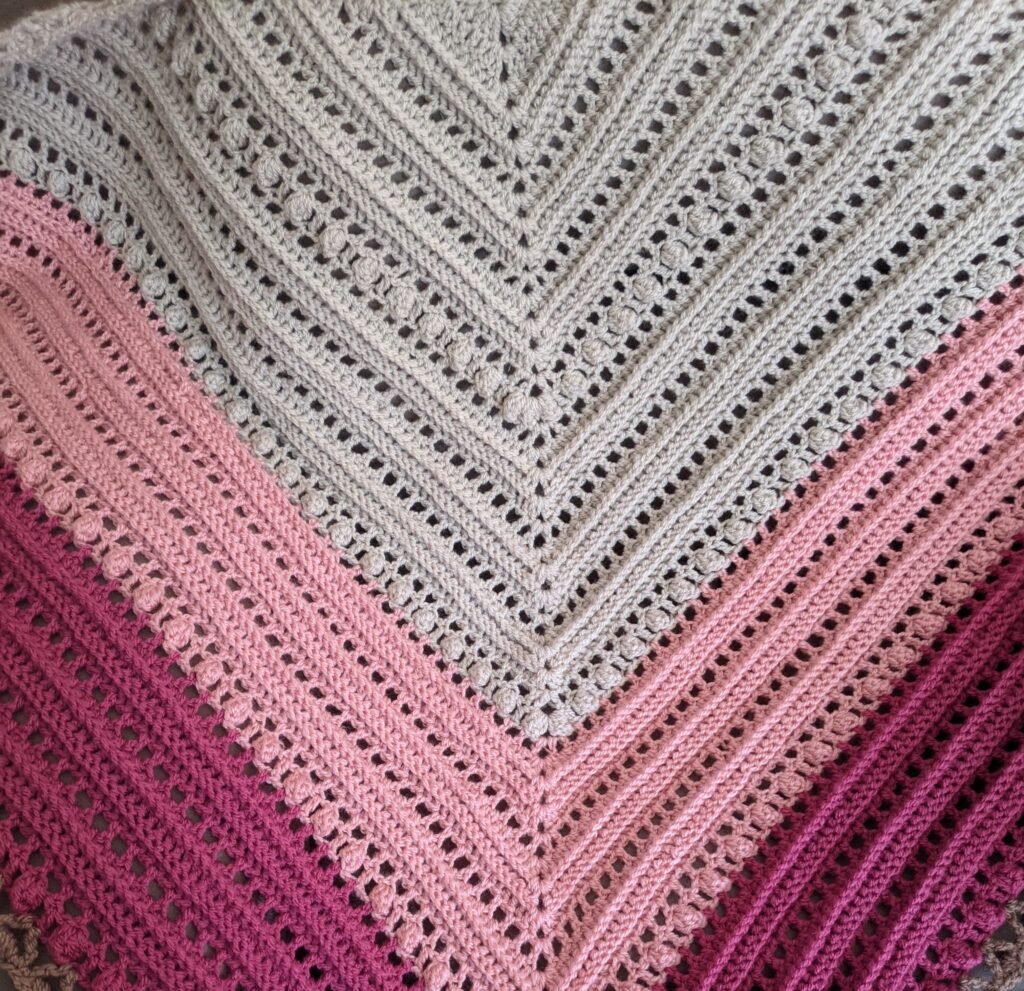
- Ombre: choose four shades of one colour, from light to dark, and work them in order.
- Seasonal: rust, mustard and deep green feel autumnal, while blues and greys suit a coastal room.
Before you buy all the yarn, try a quick test. Lay the balls side by side in the order you plan to use them and take a photo in black and white on your phone. If two colours look the same in grey, they may blur together in the blanket, so swap one for a lighter or darker shade.
You can also work a small swatch of a few groups in each colour. It takes a little time, but it is the best way to see how your granny stripe blanket will look before you commit.
Tips for neat colour changes
Clean colour changes make a big difference to the finished look of a granny stripe blanket. As the pattern notes explain, change colour on the last stitch of a row, so the new colour is ready for the turning chain.
- Leave tails of about 15cm, so there is plenty to weave in securely.
- Weave each tail into stitches of its own colour, so it does not show on the other stripes.
- If you carry a colour up the side instead of cutting it, keep the strand loose and hide it under the border later.
- Try not to pull the first stitch of a new colour too tight, as this can make the edge pucker.
Many crocheters like to weave in ends every few stripes rather than saving them all for the end. It breaks the job into small, manageable pieces.
Adding a border to your granny stripe blanket
Join colour 1 (or your favourite shade) in any corner with right side facing.
Round 1: 1 ch, then work dc evenly around all four sides: 1 dc in each st along the top and bottom edges, and 2 dc into the side of each treble row along the sides. Work (1 dc, 2 ch, 1 dc) into each corner. Join with a ss to the first dc.
Rounds 2 and 3: 1 ch, 1 dc in each dc around, working (1 dc, 2 ch, 1 dc) into each corner 2-ch sp. Join with a ss. Fasten off.
For a softer finish, work a final round of crab stitch (reverse double crochet), working dc from left to right instead of right to left.
A plain double crochet border frames the stripes and stops the edges stretching. If you would like a wider border, simply repeat Round 2 a few more times before fastening off, changing colour if you like.
Finishing your granny stripe blanket
Weave in all tails along stitches of the same colour, splitting the yarn as you go so ends do not work loose in the wash. Lay the blanket flat on towels, mist it lightly with water and pat it into shape. Leave it to dry fully before folding. Acrylic does not need pinning, but a little steam (never touching the iron to the yarn) will relax wavy edges.
Troubleshooting your granny stripe blanket
- The blanket is getting wider or narrower. Count the groups at the end of each row. Row A should have 37 groups plus 1 tr at each end, and Row B 36 groups with a half group at each end. The most common slip is missing the last stitch into the turning chain.
- The foundation edge is tight. Use the larger hook for the chain, as the pattern suggests, or work the chain more loosely.
- The sides look wavy. Check that you are alternating Row A and Row B. Working two of the same row in a row will make the edge bulge or pull in.
- The clusters lean. A little lean is normal with trebles. Gentle blocking at the end usually straightens it.
- There are lots of loose ends. Weave them in as you go, or crochet over the tails on the next row to save time later.
Mistakes in a granny stripe blanket are rarely a disaster. If you spot a problem within a row or two, pull back to that point and work it again. The fabric is forgiving and the yarn usually survives being reworked once or twice.
Customising your blanket
- Bigger sizes: for a single bed (about 140cm wide), start with 169 ch. For a double bed (about 200cm wide), start with 241 ch. Buy about 1.5 and 2.5 times the yarn respectively.
- Scrap version: change colour every row and use up odds and ends of DK. Keep one neutral colour for every fourth row so the blanket looks planned rather than random.
- Chunkier and faster: use aran yarn and a 5mm hook. Start with a smaller chain, as each group will be wider.
Yarn and care
A soft acrylic DK is the classic UK choice for a granny stripe blanket: hard-wearing, machine washable and affordable, with a huge colour range. Wool blends feel lovely but check the ball band before washing. Wash acrylic at 30 to 40 degrees on a gentle cycle and dry flat.
Store the blanket folded rather than hung, as the weight of a large blanket can stretch it over time. Keep a short length of each colour with the ball bands, so you can make small repairs later and always know how to wash it.
More projects to try next
Once your granny stripe blanket is finished, you may want to keep the treble momentum going. Our guide to the treble crochet stitch is a good refresher, and our crochet hooks guide will help if you fancy trying a new hook.
For a quick gift in between rows, the easy crochet baby booties pattern uses DK yarn too, and our easy crochet Christmas decorations are a great way to use up leftover colours.
Compare all our free crochet blanket patterns to choose your next project.
Frequently asked questions about granny stripe blanket
How big is this granny stripe blanket?
Starting with 115 chains gives a lap blanket of about 95cm by 130cm. For a single bed start with 169 chains, and for a double bed start with 241 chains.
How do I make a granny stripe blanket wider or narrower?
The foundation chain is a multiple of 3 plus 1. Add or remove chains in groups of 3 and the pattern will still work.
How much yarn do I need?
About 2,200m of DK yarn for the 95cm by 130cm size, which is roughly eight 100g balls. Allow about 1.5 times as much for a single bed and 2.5 times as much for a double.
Is a granny stripe blanket good for beginners?
Yes. Once the first row is set up you only work clusters of three trebles into the gaps of the row below, so there is very little counting.
How long does a granny stripe blanket take to make?
It depends on your speed and how often you crochet. Because the pattern is so repetitive, many people work on a granny stripe blanket in short sessions over several weeks, a few rows at a time.