This easy crochet blanket pattern is worked in just one stitch, the UK half treble, so it is a lovely first big project for a new crocheter. You chain, you work a row, you turn, and you repeat. There are no squares to join and no fiddly counting once you are under way.
At a glance: This easy crochet blanket is worked in just one stitch, the UK half treble, so it is a lovely first big project for a new crocheter. Yarn and hook: DK yarn and a 5mm (UK 6) hook (US H-8). Time: a few weeks of evening crochet. Terms: UK, with US conversions.
The pattern is written in UK crochet terms, with US terms in brackets where it helps. It comes in three sizes, a baby blanket, a lap blanket and a single bed throw, with exact chain counts, stitch counts and yarn estimates for each one.
If you would like something with more colour changes, our cosy granny stripe blanket is a great next step. This one is all about a soft, solid fabric that grows steadily row by row.
Why this easy crochet blanket is perfect for beginners
A half treble crochet blanket sits right in the sweet spot for beginners. The stitch is taller than a double crochet, so the blanket grows quickly, but it is shorter and firmer than a treble, so the fabric is warm and does not have big gaps.
- One stitch only: after the foundation chain, every stitch is a half treble (htr).
- Easy to count: the stitch count stays the same on every row, so you can check your work at the end of each row.
- Easy to resize: any number of stitches works, so you can make the crochet blanket as wide or as narrow as you like.
- Relaxing to make: once you have the rhythm, it is a perfect project for watching television or listening to the radio.
If you have never made a half treble before, take ten minutes to practise with our step-by-step guide to half treble crochet in UK terms. Once that stitch feels comfortable, you are ready to start this crochet blanket.
What you need
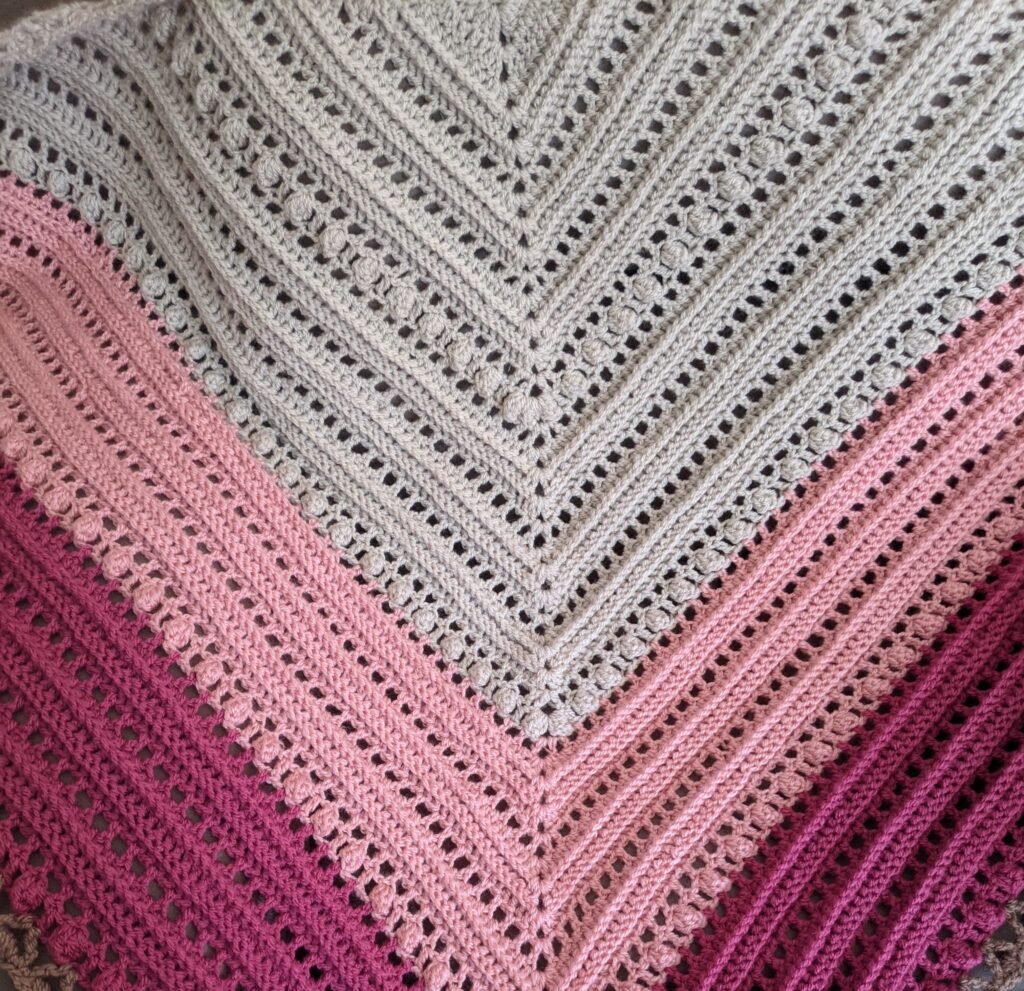
- Yarn: DK (double knitting) weight yarn for your crochet blanket. A soft, machine washable acrylic or acrylic blend is the easiest choice for a first blanket. See the size table below for amounts.
- Hook: 5mm (UK 6, US H-8). This is a little larger than the 4mm often printed on DK ball bands, which gives a softer, drapier crochet blanket.
- Tapestry needle: a large blunt needle for weaving in ends.
- Scissors and a few stitch markers (optional, but handy for marking the first and last stitch of a row).
Not sure which yarn to pick? Our guide to crochet yarn explains weights and fibres, and our crochet hooks guide covers hook sizes and handle styles.
Tension (gauge)
Using DK yarn and a 5mm hook, we aim for about 14 htr and 10 rows to 10cm. Everyone crochets a little differently, so please make a small swatch before you start.
Chain 22 and work about 12 rows following the pattern below, then measure the middle of the swatch. If you have more stitches than 14 to 10cm, try a larger hook. If you have fewer, try a smaller one. Tension does not need to be perfect for a crochet blanket, but it does affect the size and how much yarn you use.
Crochet blanket sizes and chain counts
The foundation chain for this pattern is any number of chains plus 2. The 2 extra chains are skipped at the start of Row 1 and act as the first turning chain. The number of stitches in every row is always the foundation chain minus 2.
| Size | Finished size (approx.) | Foundation chain | Stitches per row | Rows (approx.) | DK yarn (approx.) |
|---|---|---|---|---|---|
| Baby blanket | 73cm x 80cm | 100 ch | 98 htr | 77 | 1,400m to 1,600m (about 5 to 6 x 100g balls) |
| Lap blanket | 103cm x 130cm | 142 ch | 140 htr | 127 | 3,100m to 3,500m (about 11 to 12 x 100g balls) |
| Single bed throw | 133cm x 190cm | 184 ch | 182 htr | 187 | 5,900m to 6,500m (about 21 to 23 x 100g balls) |
The yarn amounts are estimates for a DK yarn of roughly 280m to 300m per 100g, and they include the border. Solid stitches use more yarn than open, lacy ones, so buy an extra ball in the same dye lot if you can. It is much easier than trying to match a colour later.
The finished sizes include a border of about 1.5cm on each side. Your blanket may come out slightly larger or smaller depending on your tension.
A note on the baby size
The baby size crochet blanket is a nice pram, play mat or cuddle blanket. For sleep, always follow the safe sleep advice on the NHS baby pages: place babies on their back with their feet at the foot of the cot, tuck any blanket in no higher than their shoulders, and keep loose bedding out of the cot for very young babies. Never add buttons, beads or long ties to a baby blanket.
Easy crochet blanket pattern for beginners (UK terms)
Abbreviations (UK): ch = chain, st(s) = stitch(es), htr = half treble (US half double crochet, hdc), dc = double crochet (US single crochet, sc), ss = slip stitch.
Note: the ch 2 at the start of each row is a turning chain and does not count as a stitch. Work your first htr into the very first stitch of the row, and your last htr into the last stitch, not into the turning chain.
Foundation chain
Make a slip knot and chain the number shown for your size: 100 ch (baby), 142 ch (lap) or 184 ch (single bed). Chain loosely. If your foundation chain is tight, the bottom edge of the crochet blanket will pull in, so you can use a hook one size larger just for the chain.
Row 1
Htr in the 3rd ch from the hook, then htr in each ch to the end. Turn.
Stitch count: 98 htr (baby), 140 htr (lap), 182 htr (single bed).
Row 2
Ch 2 (does not count as a st), htr in the first st and in each st to the end. Turn.
Stitch count: 98 htr (baby), 140 htr (lap), 182 htr (single bed).
Rows 3 onwards
Repeat Row 2 until the blanket measures about 77cm (baby), 127cm (lap) or 187cm (single bed), or about 3cm less than the length you want. This leaves room for the border. Fasten off at the end of the last row, or keep your loop on the hook to go straight into the border.
Count your stitches every few rows, especially near the start. If the count drops, you have probably missed the first or last stitch. If it rises, you may have worked into the turning chain.
Adding a simple border to your crochet blanket
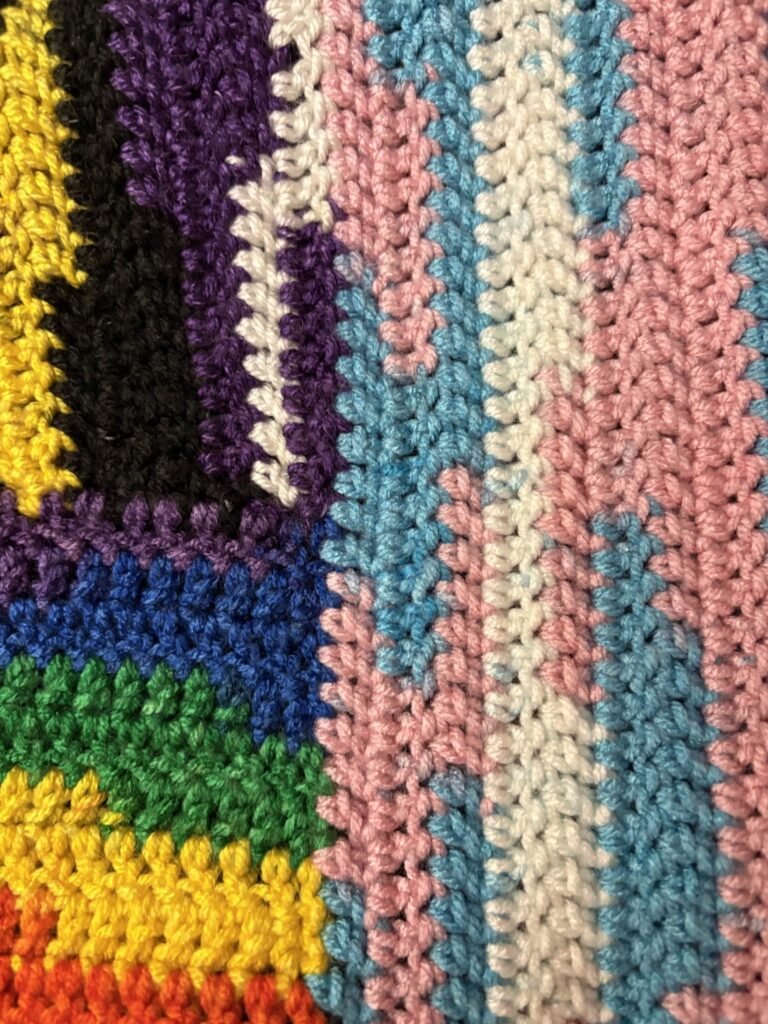
A border tidies the edges and hides any small wobbles in the row ends. This one is three rounds of double crochet (US single crochet). You can work it in the main colour or in a contrast shade.
Round 1: with the right side facing, join yarn in any corner (or carry on from the last row). Ch 1 (does not count as a st). Work 3 dc into each corner. Along the top and bottom edges, work 1 dc into each st or ch. Along the side edges, work about 3 dc for every 2 row ends. Ss to the first dc to join.
Round 2: ch 1, dc in each dc around, working 3 dc into the centre dc of each 3-dc corner. Ss to the first dc to join.
Round 3: repeat Round 2. Fasten off.
The aim is a flat edge. If the side edges ruffle, you have too many stitches, so work 2 dc for every 2 row ends in some places. If the edges pull in or curl, add an extra dc here and there.
How to join new yarn in a crochet blanket
Every crochet blanket uses several balls of yarn, so you will need to join new yarn more than once. The neatest place is at the end of a row, where the join is hidden in the side edge and later covered by the border.
- Work the last htr of the row until you have 3 loops on the hook (yarn over, insert hook, yarn over and pull up a loop).
- Drop the old yarn, leaving a tail of about 10cm.
- Pick up the new yarn, yarn over with it and pull it through all 3 loops.
- Leave a 10cm tail of the new yarn too, then turn and carry on.
This same method is how you change colour if you want stripes. Simply change on the last stitch of the row before the new colour starts.
If you run out in the middle of a row, you can join in the same way mid-row. You can also work over the yarn tails for a few stitches to hold them in place, but still weave them in properly afterwards.
Weaving in ends neatly
Weaving in ends is the part nobody loves, but it makes a big difference to how your crochet blanket wears and washes. A blanket gets pulled and washed a lot, so take a little care here.
- Thread the tail onto a tapestry needle.
- Weave it through the back of the stitches for about 5cm in one direction.
- Change direction and weave back for 2cm to 3cm, then change direction once more.
- Gently stretch the fabric, then trim the tail close to the surface.
Changing direction locks the end in place so it does not work loose in the wash. On a striped crochet blanket, weave each tail into stitches of the same colour so it does not show on the front.
A tip: weave in ends as you go, perhaps every time you finish a ball. Facing dozens of ends at the very end can feel like a chore.
Blocking and washing your crochet blanket
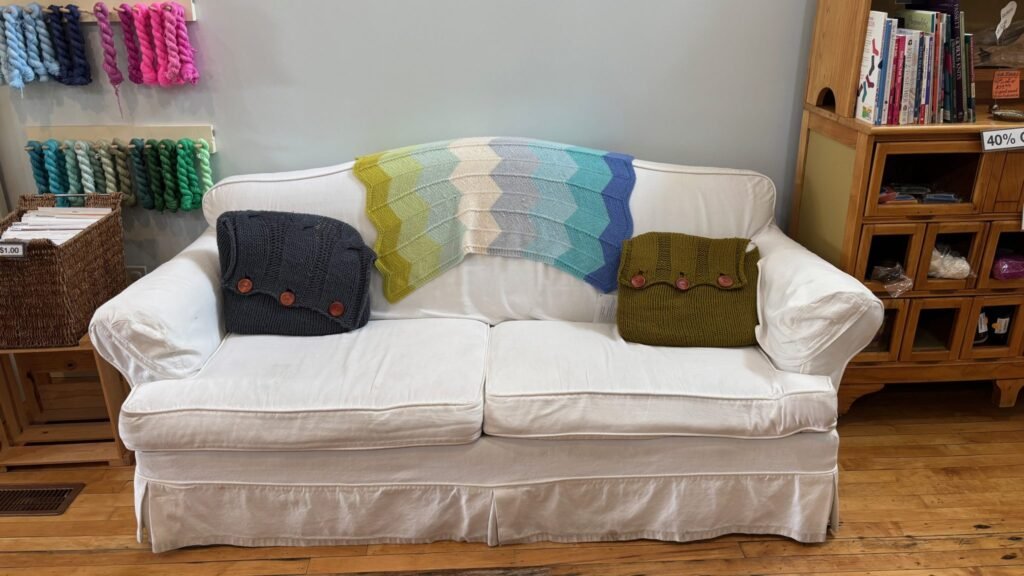
Blocking evens out the stitches, straightens the edges and helps the blanket lie flat. The method depends on the fibre, so check your ball band first.
Acrylic and acrylic blends
Lay the crochet blanket flat on towels or foam mats and gently pat it into shape. Hold a steam iron a few centimetres above the fabric and let the steam soak in. Do not press the iron onto the stitches, because heat can flatten acrylic permanently. Leave the blanket to cool and dry before moving it.
Wool and cotton
Soak the blanket in cool water with a little wool wash, then gently squeeze out the water. Never wring it. Roll it in a towel to remove more water, lay it flat, ease it into shape and leave it to dry completely.
Everyday washing
- Follow the care symbols on the ball band for washing temperature and drying.
- Many acrylic yarns are fine on a gentle machine cycle. Wool usually needs a hand wash or a wool cycle.
- Dry flat if you can. A heavy, wet blanket can stretch if it is hung on a line.
- Keep the ball band from one ball with the finished blanket, or take a photo of it, so anyone who receives it knows how to care for it.
Ideas to make it your own
The plain half treble fabric is a lovely canvas. Once you have finished your first crochet blanket, try one of these simple changes.
- Stripes: change colour every 4 or 6 rows using the joining method above.
- Back loop only: work every htr into the back loop only for a gentle ridged texture.
- Between the stitches: work each htr into the gap between two stitches of the row below instead of the top of the stitch. This gives a soft, woven look. Work one htr into the gap before the first stitch and one into each gap after that, then count to check the total has not changed.
- Contrast border: work the three border rounds in a darker or brighter shade to frame the blanket.
When you are ready for taller stitches, our guide to treble crochet in UK terms will help, and the granny stripe pattern uses trebles throughout.
Common problems and how to fix them
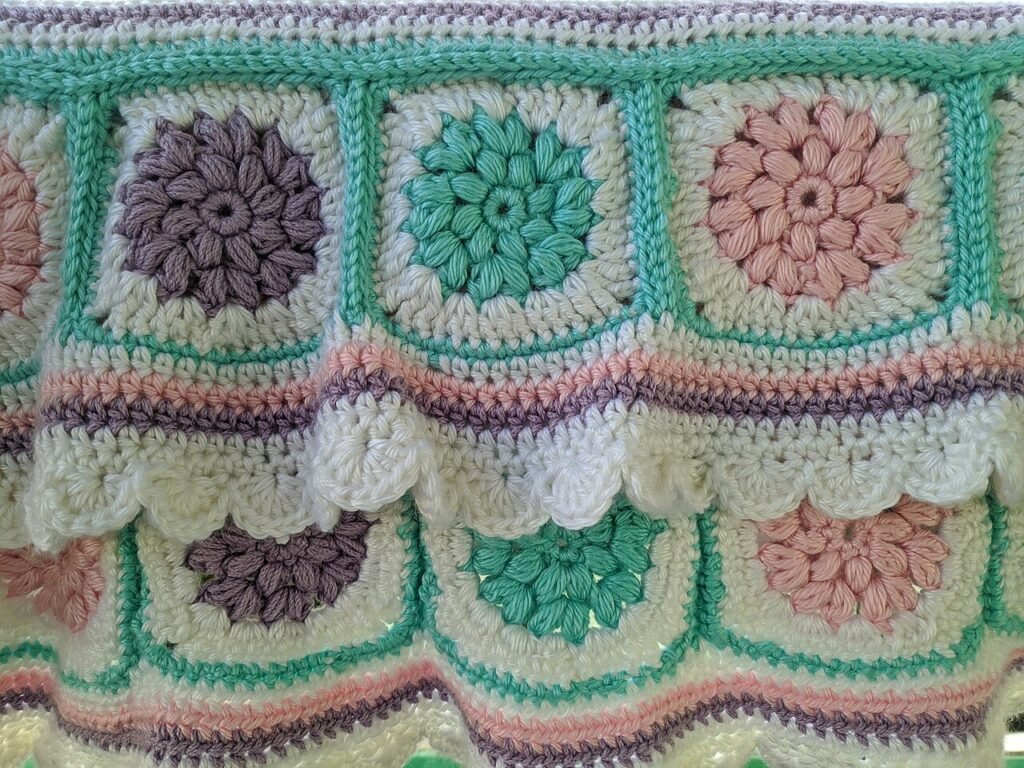
The edges are not straight
Wavy or slanting edges almost always mean the stitch count has changed. Put a stitch marker in the first and last stitch of each row so you can see exactly where to work. Count at the end of each row until you are confident.
The blanket is getting narrower or wider
If it narrows, you are missing the first or last stitch. If it widens, you are working into the turning chain or adding an extra stitch. Pull back to the last correct row, it is quicker than it sounds.
The bottom edge is tighter than the rest
This is a tight foundation chain. For your next crochet blanket, make the chain with a hook one or two sizes larger, then switch back to your main hook for Row 1.
The fabric feels stiff
Try a larger hook. A 5.5mm or 6mm hook with DK yarn gives a looser, softer fabric. Make a new swatch first, because it will change your size and yarn amounts.
More free crochet blanket patterns
Once you have finished this easy crochet blanket pattern, you have all the skills for the next one. Here are our other free crochet blanket patterns, all written in UK terms, from the simplest to the most eye-catching.
Which crochet blanket pattern should I choose?
| Pattern | Skill level | Yarn | Best for |
|---|---|---|---|
| Easy half treble blanket (this page) | Beginner | DK | Your very first blanket |
| Granny stripe blanket | Beginner | DK | Using up colourful scraps |
| Moss stitch blanket | Beginner | DK | A neat, woven-look texture |
| Corner to corner (C2C) blanket | Beginner | Aran | Pictures and pixel designs |
| Temperature blanket | Beginner | DK | A year-long project, one row a day |
| Six-point star blanket | Advanced beginner | DK | A show-stopping round blanket |
| Christmas granny square blanket | Beginner | DK | A festive throw for the sofa |
| Baby blanket (3 patterns) | Easy | DK | Gifts for a new arrival |
| Newborn blanket | Easy | DK | A small, quick baby gift |
Whichever crochet blanket pattern you pick, finish it with one of the edgings in our crochet blanket border guide.
Easiest crochet blanket patterns for beginners
If this is your first crochet blanket, stick to patterns worked in rows of a single stitch: this half treble blanket, the moss stitch blanket or the granny stripe. They need no joining, the stitch count stays the same on every row, and mistakes are easy to spot and fix.
Quick crochet blanket patterns
To finish faster, use a thicker yarn and a bigger hook. A chunky yarn with an 8mm hook makes the half treble blanket on this page roughly twice as fast as DK. Baby and newborn blankets are also quick, because they are much smaller than a throw.
How long does it take?
This depends on your speed and how often you crochet, so we will not give a fixed number of hours. A baby size crochet blanket is a satisfying few weeks of evening crochet for most beginners, and a single bed throw is a longer project to enjoy over the colder months.
The good news is that half treble crochet speeds up a lot with practice. Your last rows will be much quicker than your first ones.
Make a matching crochet pillow for your blanket with our easy cushion cover patterns.
Want a bold modern blanket? Learn mosaic crochet for beginners.
Frequently asked questions about crochet blanket making
What is the easiest stitch for a crochet blanket?
Half treble (US half double crochet) is one of the easiest choices. It is quick to work, makes a warm, solid fabric and is simple to count. Double crochet is also easy but slower, as the stitches are shorter.
How many chains do I need for a crochet blanket?
For this pattern, chain the number of stitches you want plus 2. With DK yarn and a 5mm hook, that is 100 ch for the baby size, 142 ch for the lap size and 184 ch for the single bed throw.
How much yarn do I need for a crochet blanket?
For this half treble pattern in DK, allow about 1,400m to 1,600m for a baby size, 3,100m to 3,500m for a lap blanket and 5,900m to 6,500m for a single bed throw. Buy an extra ball from the same dye lot.
What yarn is best for a first crochet blanket?
A smooth, light coloured DK yarn in acrylic or an acrylic blend is easiest. It shows your stitches clearly, is soft and affordable, and can usually be machine washed. Avoid fluffy or very dark yarn for your first blanket.
Why is my crochet blanket curling?
Curling usually comes from a tight foundation chain or very tight tension. Use a bigger hook for the chain, relax your grip, and block the finished blanket. A dc border also helps the edges lie flat.
What is the best crochet blanket pattern for beginners?
A blanket worked in rows of one stitch, such as this half treble crochet blanket pattern, is the easiest. The granny stripe and moss stitch blankets are good next steps.
Are these crochet blanket patterns free?
Yes. Every crochet blanket pattern on Cosy Hook Corner is free to read and print for personal use, with UK terms and US conversions.