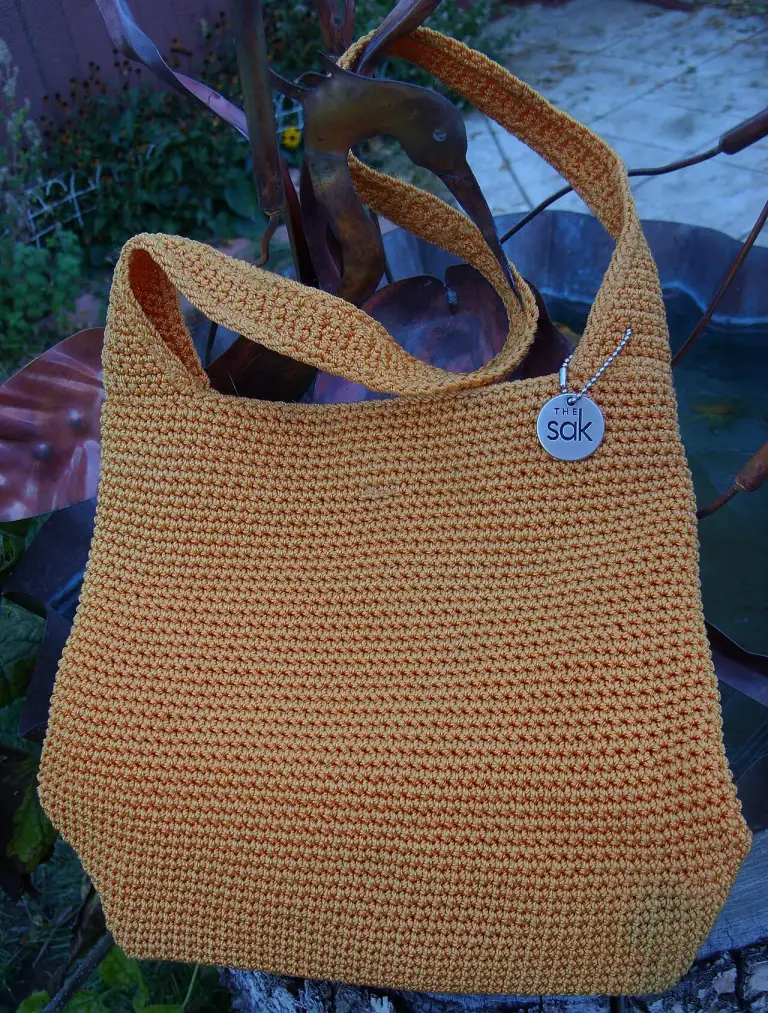
A crochet purse is a lovely first bag project. It is small, so it works up quickly, it uses only one or two balls of yarn, and you end up with something useful you can carry every day or give as a gift. Purses are also the perfect way to practise working in the round, adding a zip and making a strap.
This page has three free crochet purse patterns in UK terms with US conversions: a zip coin purse, a drawstring crossbody bucket purse and an envelope clutch with a button flap. All three are beginner friendly, with exact stitch counts, a diagram, and tips on lining your purse so it lasts.
Quick answer: To crochet a purse, choose a firm cotton yarn and work the body in tight stitches. For a coin purse, work double crochet in rounds around a 21-chain foundation and sew in a 10cm zip. For a crossbody purse, crochet a flat circle base, work straight sides in half trebles and add a drawstring and strap. For a clutch, crochet a rectangle, fold it into an envelope and add a button.
Why make a crochet purse?
- Quick to finish. The coin purse takes about an hour, and even the crossbody bag is a weekend make.
- Uses little yarn. One 50g ball of cotton makes a coin purse; two to three balls make the bigger designs.
- Easy stitches. All three patterns use only double crochet, half treble and treble, plus simple chains.
- Great gifts. A handmade purse in someone's favourite colour is a thoughtful birthday or Christmas present.
If you want a larger shopping bag, see our crochet bag patterns for a market bag, a tote and a granny square bag.
What you need
| Item | What to use |
|---|---|
| Yarn | Cotton or cotton blend: DK for the coin purse and clutch, aran for the bucket purse (amounts are given with each pattern) |
| Hooks | 3.5mm (UK 9, US E-4), 4mm (UK 8, US G-6) and 5mm (UK 6, US H-8) |
| Hardware | A 10cm zip for the coin purse, a 2cm button for the clutch |
| Extras | Cotton fabric for lining (optional), sewing needle and thread, tapestry needle, stitch marker, scissors |
Not sure which hook to buy? Our crochet hook size guide has a full UK and US conversion chart.
The best yarn for a crochet purse
Cotton is the best choice for a crochet purse. It is strong, it does not stretch out of shape when you carry keys and a phone, and it does not go fuzzy. Mercerised cotton has a soft shine that looks smart for a clutch, while matt recycled cotton or cotton blends are lovely for a casual crossbody purse. Avoid very soft acrylics and wool for bags, as they stretch and pill.
The coin purse and clutch use DK, which is weight 3 (light), and the bucket purse uses aran, weight 4 (medium), in the Craft Yarn Council yarn weight system. Work a little tighter than you would for a blanket, so the fabric is firm and small items cannot slip through.
Abbreviations (UK terms)
| UK term | US term | Meaning |
|---|---|---|
| MR | MR | magic ring |
| ch | ch | chain |
| sl st | sl st | slip stitch |
| dc | sc | double crochet (US single crochet) |
| htr | hdc | half treble crochet (US half double crochet) |
| tr | dc | treble crochet (US double crochet) |
| inc | inc | 2 stitches in the same stitch |
| BLO | BLO | back loop only |
| sk | sk | skip |
| sp | sp | space |
If you usually follow US patterns, keep our UK vs US crochet terms chart open while you work.
The three crochet purse patterns at a glance
The diagram shows how each purse is built, with its stitch counts and finished size.
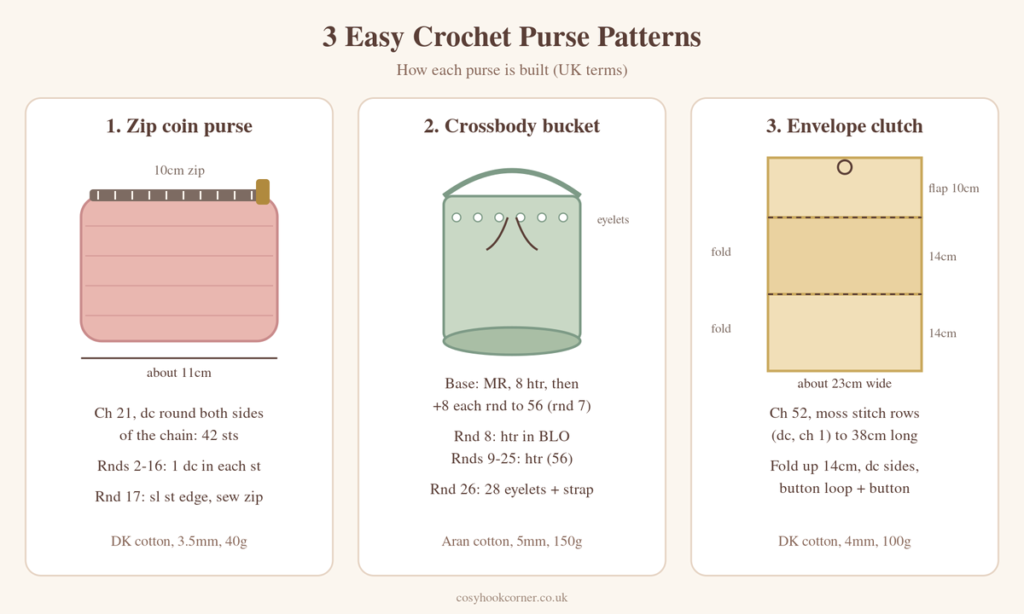
| Purse | Finished size | Yarn | Hook | Time |
|---|---|---|---|---|
| Zip coin purse | about 11 x 8cm | 40g DK cotton | 3.5mm | 1 to 2 hours |
| Crossbody bucket purse | about 14cm across, 20cm tall | 150g aran cotton | 5mm | 5 to 7 hours |
| Envelope clutch | about 23 x 14cm | 100g DK cotton | 4mm | 4 to 6 hours |
Pattern 1: zip coin purse
This little crochet coin purse is worked in rounds around a foundation chain, so there are no side seams. It fits coins, cards, earbuds or lip balm.
Yarn and hook: about 40g DK cotton and a 3.5mm hook. Tension: 20 dc and 22 rounds = 10cm.
Foundation: ch 21.
Rnd 1: 1 dc in the 2nd ch from hook, 1 dc in each of the next 18 ch, 3 dc in the last ch. Turn the work so you can crochet along the other side of the chain, then 1 dc in each of the next 18 ch, 2 dc in the last ch (the one that already holds the first dc). Sl st to the first dc. (42)
Rnd 2: ch 1 (does not count as a st), 1 dc in each st around, sl st to the first dc. (42)
Rnds 3 to 16: repeat rnd 2. For stripes, change colour every 3 rounds. The purse should measure about 8cm from the base.
Rnd 17: ch 1, 1 sl st in each st around for a neat, firm top edge. Fasten off and weave in the ends.
Add the zip: lay the purse flat and pin a 10cm zip inside the opening, with the teeth just below the top edge. Sew it in place with small backstitches through the zip tape and the inside of the top round, using sewing thread in a matching colour. Keep the zip closed while you pin, so the two sides line up.
Clip a lobster clasp or one of our crochet keychains to the zip pull for an extra pretty finish.
Pattern 2: crossbody bucket purse
This round crochet purse has a flat circular base, straight sides worked in half trebles, a drawstring top and a long strap to wear across your body. It is the right size for a phone, purse and keys.
Yarn and hook: about 150g aran cotton and a 5mm hook. Tension: 13 htr and 10 rounds = 10cm.
Base
Work in joined rounds. The ch 2 at the start of each round does not count as a stitch.
Rnd 1: make a MR, ch 2, 8 htr into the ring. Pull the ring closed and sl st to the first htr. (8) New to the technique? See our magic ring tutorial.
Rnd 2: ch 2, 2 htr in each st around, sl st to the first htr. (16)
Rnd 3: ch 2, (1 htr, inc) x8, sl st to the first htr. (24)
Rnd 4: ch 2, (2 htr, inc) x8, sl st to join. (32)
Rnd 5: ch 2, (3 htr, inc) x8, sl st to join. (40)
Rnd 6: ch 2, (4 htr, inc) x8, sl st to join. (48)
Rnd 7: ch 2, (5 htr, inc) x8, sl st to join. (56) The base is now about 14cm across.
Sides
Rnd 8: ch 2, 1 htr in the BLO of each st around, sl st to join. (56) Working into the back loops makes a crisp edge so the purse stands up.
Rnds 9 to 25: ch 2, 1 htr in each st around, sl st to join. (56) The sides should measure about 17cm.
Eyelets and top
Rnd 26: ch 4 (counts as 1 tr and ch 1), sk 1 st, *1 tr in the next st, ch 1, sk 1 st; rep from * around, sl st to the 3rd ch of the starting ch-4. (28 eyelets)
Rnd 27: ch 1, *1 dc in the next tr, 1 dc in the ch-1 sp; rep from * around, sl st to the first dc. (56)
Rnds 28 and 29: ch 1, 1 dc in each st around, sl st to join. Fasten off.
Drawstring and strap
Drawstring: make a chain about 70cm long, then work 1 sl st in the back bump of each chain. Thread it through the eyelets and knot the ends.
Strap: ch 5. Row 1: 1 dc in the 2nd ch from hook and in each ch to the end, turn. (4) Row 2: ch 1, 1 dc in each st, turn. (4) Repeat row 2 until the strap is about 110cm long, or the length you like. Sew the ends securely to the inside of opposite sides of the purse, just below the eyelet round.
Pattern 3: envelope clutch purse
This flat crochet clutch is a simple rectangle in moss stitch (also called linen stitch), folded up like an envelope and closed with a button. The woven-looking stitch is firm, so it holds its shape without a frame.
Yarn and hook: about 100g DK cotton and a 4mm hook. Tension: 22 sts and 22 rows = 10cm in moss stitch (count each dc and each ch-1 sp as one stitch).
Foundation: ch 52.
Row 1: 1 dc in the 4th ch from hook, *ch 1, sk 1 ch, 1 dc in the next ch; rep from * to the end, turn. (25 dc)
Row 2: ch 2, 1 dc in the first ch-1 sp, *ch 1, 1 dc in the next ch-1 sp; rep from * to the end, working the last dc into the turning-ch space, turn.
Repeat row 2 until the piece measures about 38cm. Do not fasten off.
Button loop: on the last row, when you reach the centre stitch, ch 8 and sl st into the same stitch to make a loop, then finish the row. Fasten off.
Making up: lay the rectangle flat with the button loop at the top. Fold the bottom edge up by 14cm to form the pocket. Join the sides by working dc through both layers along each side, then carry on in dc around the edge of the flap for a neat border. Fold the flap down and sew a 2cm button to the front so it lines up with the loop.
For a pretty finish, sew a small puffy heart from our crochet heart pattern onto the flap, or add a row of bobbles from our bobble stitch tutorial.
How to line a crochet purse
A fabric lining stops small things from poking through the stitches and keeps your crochet purse from stretching. It is optional, but it makes a big difference for the bucket purse and the clutch.
- Measure the finished purse inside and add 1.5cm all round for seam allowance.
- Cut two pieces of cotton fabric to that size (or, for the bucket purse, a circle for the base and a rectangle for the sides).
- Sew the lining pieces into a pouch with the right sides facing, leaving the top open.
- Fold the top edge of the lining over by 1.5cm and press it.
- Slip the lining inside the purse and hand sew the folded edge to the inside of the top round with small whip stitches.
If you do not sew, iron-on interfacing applied to a fabric lining also works well for the clutch.
Ideas for your crochet purse
- Two-colour stripes: change colour every 4 rounds on the bucket purse for a summery look.
- Granny square purse: join two granny squares, sew three sides and add a zip for a quick retro coin purse.
- Wooden handles: skip the strap on the bucket purse and sew on a pair of round wooden handles instead.
- Chain strap: attach two D-rings to the clutch and clip on a metal chain to turn it into a shoulder purse.
- Matching set: make a coin purse and a crochet basket in the same colours as a gift set.
Common problems and how to fix them
The bucket purse base is wavy
Your tension is looser than 13 htr to 10cm, or you have too many increases. Go down half a hook size, and count each round carefully.
The coin purse leans to one side
Rounds worked with a slip stitch join can drift. Turn your work at the end of every round, or work in a continuous spiral and move your stitch marker up each round.
The zip is wavy after sewing
The crochet stretched while you sewed. Pin the zip with the purse lying flat and the zip closed, and use small stitches without pulling tight.
The strap stretches
Cotton straps can grow with use. Make the strap 10cm shorter than you want, or sew a strip of cotton webbing behind it.
Frequently asked questions about crochet purses
Is a crochet purse easy for beginners?
Yes. All three patterns use only basic stitches. The zip coin purse is the easiest place to start, as it is small and worked in double crochet.
How much yarn do I need for a crochet purse?
About 40g of DK cotton for a coin purse, 100g of DK cotton for a clutch and 150g of aran cotton for a crossbody bucket purse.
What is the best yarn for a crochet purse?
Cotton or a cotton blend. It is strong, holds its shape and does not stretch or go fuzzy like wool and soft acrylic.
Do I need to line a crochet purse?
It is not essential, but a fabric lining stops small items slipping through the stitches and helps the purse keep its shape.
Can I make these crochet purse patterns in US terms?
Yes. Use US single crochet for dc, half double crochet for htr and double crochet for tr. The stitch counts stay the same.