A crochet balaclava is a hat, hood and neck warmer in one. It keeps your head, ears and neck warm at the same time, it stays put in the wind, and it has become one of the most popular winter makes of the last few years. The good news is that a balaclava is much easier to crochet than it looks.
This free crochet balaclava pattern is written in UK terms with US conversions and exact stitch counts for every round. It starts at the crown like a hat, so there is no seam and no pointy top. You work a few rows to make the face opening, join back into rounds for the neck, and finish with a ribbed collar that tucks into your coat. There are child and adult sizes, a diagram, and tips to stop the face opening stretching.
Quick answer: To crochet a balaclava, start at the crown with a magic ring and work increasing rounds of half treble crochet to 64 or 72 stitches, then plain rounds until it reaches your eyebrows. Work rows over all but 16 or 18 stitches to make the face opening, chain across to close it, then work the neck and a flared ribbed collar in rounds. Finish the face with a round of double crochet and a round of slip stitch.
Why this crochet balaclava pattern works
- No pointy top. The crown is a flat circle worked in rounds, so the top of the head is round, not shaped like elf ears.
- No seams. The whole balaclava is one piece. The face opening forms by itself when you work a few rows instead of rounds.
- One main stitch. It is all half treble crochet, with a double crochet edge around the face.
- Made to fit. You try it on as you go, so it fits your head and face perfectly.
If you can crochet a crochet hat in the round, you can make this crochet balaclava. The crown starts with a magic ring; see our magic ring tutorial if it is new to you.
What you need
| Item | What to use |
|---|---|
| Yarn | Soft aran (worsted) merino, merino blend or soft acrylic: about 100g for the child size, 150g for the adult size |
| Hooks | 5mm (UK 6, US H-8) for the main part, 4.5mm (UK 7, US 7) for the face edging |
| Extras | 2 stitch markers, tapestry needle, scissors, a tape measure |
Not sure which hook you have? Our crochet hook size guide has a UK and US conversion chart.
The best yarn for a crochet balaclava
A balaclava sits against your cheeks, chin and mouth, so the yarn needs to be soft and comfortable to breathe through. These are the most important things to look for:
- Softness first. Merino wool and merino blends are the softest wools, and good quality acrylic is a gentle, washable alternative. Avoid scratchy wool and hairy yarns such as mohair, which tickle your nose and mouth.
- Moisture. When you breathe through a balaclava, the fabric around your mouth gets damp. Wool absorbs moisture and still feels warm when it is a little damp, while acrylic feels colder and wetter. A merino and acrylic blend is a good balance.
- Some stretch. Wool and wool blends have natural elasticity, which helps the face opening spring back into shape.
Aran is weight 4 (medium) in the Craft Yarn Council yarn weight system. Our crochet yarn guide explains the other weights and fibres.
Abbreviations (UK terms)
| UK term | US term | Meaning |
|---|---|---|
| MR | MR | magic ring |
| ch | ch | chain |
| sl st | sl st | slip stitch |
| dc | sc | double crochet (US single crochet) |
| htr | hdc | half treble crochet (US half double crochet) |
| inc | inc | 2 htr in the same stitch |
| st(s) | st(s) | stitch(es) |
If you usually follow US patterns, keep our UK vs US crochet terms chart open while you work.
Why half treble crochet?
Half treble crochet (US half double crochet) is the best stitch for a crochet balaclava. Double crochet makes a dense, stiff fabric that is warm but does not drape around the face, and it takes much longer to work. Treble crochet is quick but leaves gaps that let the wind in. Half trebles sit in the middle: the fabric is warm and windproof, but still soft and stretchy enough to pull over your head. Our half treble crochet guide shows the stitch step by step.
Tension and sizes
14 htr and 10 rounds = 10cm on a 5mm hook. Check your tension after the crown: the flat circle should measure about 16cm (18cm) across.
Instructions are written for the child size, with the adult size in brackets. Where there is only one number, it is the same for both sizes.
| Size | Head circumference | Stitches around | Face opening | Yarn |
|---|---|---|---|---|
| Child (about 4 to 10 years) | 48 to 52cm | 64 | 16 sts wide, about 9cm tall | about 100g |
| Adult | 54 to 58cm | 72 | 18 sts wide, about 11cm tall | about 150g |
How the crochet balaclava is made
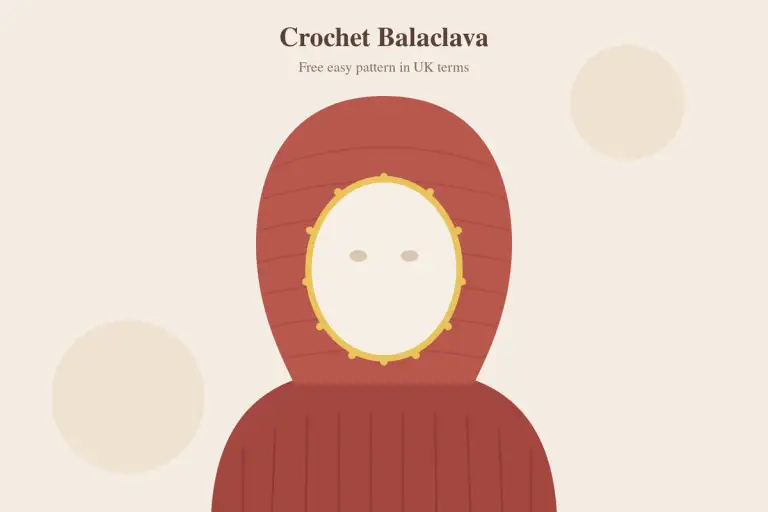
The diagram shows the four parts: the crown in increasing rounds, the head in plain rounds, the face opening in rows, and the neck and collar in rounds with a few increases so it sits flat on your shoulders.
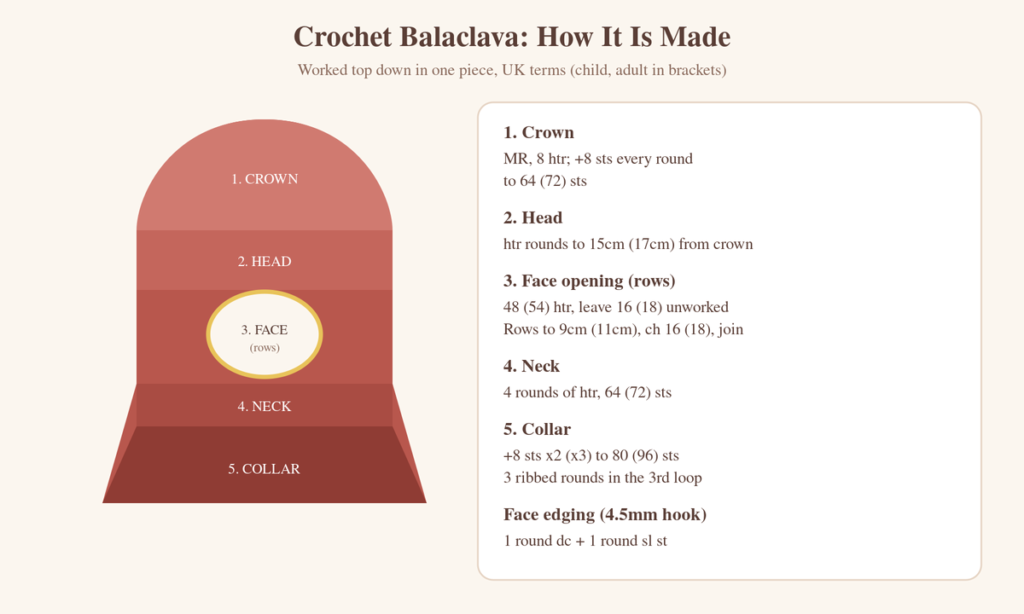
Free crochet balaclava pattern
Work in joined rounds. The ch 2 at the start of each round or row does not count as a stitch. Place a marker in the first stitch of each round.
Crown
Rnd 1: make a MR, ch 2, 8 htr into the ring. Pull the ring closed and sl st to the first htr. (8)
Rnd 2: ch 2, inc in each st around, sl st to join. (16)
Rnd 3: ch 2, (1 htr, inc) x8, sl st to join. (24)
Rnd 4: ch 2, (2 htr, inc) x8, sl st to join. (32)
Rnd 5: ch 2, (3 htr, inc) x8, sl st to join. (40)
Rnd 6: ch 2, (4 htr, inc) x8, sl st to join. (48)
Rnd 7: ch 2, (5 htr, inc) x8, sl st to join. (56)
Rnd 8: ch 2, (6 htr, inc) x8, sl st to join. (64)
Adult size only, rnd 9: ch 2, (7 htr, inc) x8, sl st to join. (72)
You now have 64 (72) sts. Stagger the increases on alternate rounds (work half the plain stitches before the first increase) if you want an extra smooth, round crown.
Head
Next rnds: ch 2, 1 htr in each st around, sl st to join. (64 (72))
Repeat this round until the crochet balaclava measures 15cm (17cm) from the centre of the crown. Try it on: the edge should reach your eyebrows. The crown is a perfect circle, so you can turn it so the join of the rounds sits at one side of your face. That join is where the face opening starts.
Face opening
Now work in rows, turning at the end of each row, so a gap opens at the front.
Row 1: ch 2, turn, 1 htr in each of the next 48 (54) sts, turn. Leave the last 16 (18) sts unworked: these form the top edge of the face opening. (48 (54))
Row 2: ch 2, 1 htr in each st to the end, turn. (48 (54))
Repeat row 2 until the opening measures 9cm (11cm), or reaches just below your chin when you try it on. End after a right-side row.
Closing round: ch 16 (18), and sl st into the first htr of the last row to close the opening. Then ch 2, 1 htr in each of the 48 (54) sts and 1 htr in each of the 16 (18) chains, sl st to join. (64 (72))
Neck
Next 4 rnds: ch 2, 1 htr in each st around, sl st to join. (64 (72))
Collar
The collar flares out gently so it lies flat over your shoulders and tucks into your coat.
Increase rnd 1: ch 2, (7 (8) htr, inc) x8, sl st to join. (72 (80))
Increase rnd 2: ch 2, (8 (9) htr, inc) x8, sl st to join. (80 (88))
Adult size only, increase rnd 3: ch 2, (10 htr, inc) x8, sl st to join. (96)
Ribbed edge, 3 rnds: ch 2, 1 htr in the third loop of each st around, sl st to join. Working into the third loop (the horizontal bar on the back of each half treble) makes a ribbed edge that looks knitted. Fasten off.
Face edging
The face edging is what makes a crochet balaclava look neat. Change to the 4.5mm hook. Join the yarn at the bottom corner of the face opening.
Edging rnd 1: ch 1, work dc evenly around the opening: 1 dc in each of the 16 (18) chains along the chin, 2 dc into the side of each row up one side, 1 dc in each of the 16 (18) unworked sts along the top, and 2 dc into the side of each row down the other side. Sl st to the first dc.
Edging rnd 2: 1 sl st in each dc around. Fasten off and weave in all the ends.
How to stop a crochet balaclava face opening stretching
The face opening is the part of a crochet balaclava that gets the most wear. Every time you pull it on and off, the edge is stretched, and after a few weeks a loose opening can start to sag around your chin. These steps keep it neat for the whole winter:
- Use a smaller hook for the edging. Working the face edging half a size smaller than the main hook pulls the edge in slightly and makes it firmer.
- Do not skip the slip stitch round. The second round of slip stitches acts like a binding. It stops the double crochet edge from stretching.
- Count the side stitches. Two dc for every row of half trebles is right for most people. If the edge ripples, work fewer; if it pulls tight, work more.
- Pull it on from the back. Put the balaclava on by pulling the back of the neck over your head, not by tugging the face opening.
- Refresh it. If the edge does relax, a quick wash and dry flat usually brings wool back into shape.
Blocking and finishing
Blocking gives your crochet balaclava a smooth, professional finish. Wet the balaclava, squeeze out the water in a towel, and pull it over a head form, a balloon blown up to head size, or a large bowl. Pat the crown into a smooth dome and the collar flat, then leave it to dry completely. Acrylic yarn can be steam blocked instead: hold a steam iron just above the fabric without touching it, then let it cool before you move it.
Crochet balaclava styles you can make from this pattern
Once you have made one crochet balaclava, it is easy to change the style. These variations all use the same crown, head and face opening, so the stitch counts above still work:
| Style | What to change | Best for |
|---|---|---|
| Classic ribbed balaclava | Work every round of the head in the third loop, not just the collar | A sporty, knitted look |
| Hooded cowl balaclava | Make the face opening 4 rows taller and skip the face edging slip stitch round, so the hood falls loosely around the face | Pulling down as a cowl when you are indoors |
| Tie balaclava | Stop after the neck rounds (no collar) and sew a 40cm crochet tie to each side of the neck | A fashionable look that ties under the chin |
| Granny square balaclava | Replace the collar with a row of small granny squares joined in a ring | Using up colourful scraps |
| Child's animal balaclava | Add two ears to the crown and a contrast face edging | School runs and playground fun |
Whichever style you choose, keep the face edging firm and try the crochet balaclava on at each stage. A balaclava should feel snug around the face without pressing on your eyes or pulling at your chin. If you make one for a child, choose a stretchy yarn and make the face opening a little larger, so it is easy to pull on and off quickly.
A crochet balaclava also makes a thoughtful handmade gift. Because the adult size fits most heads between 54 and 58cm, you do not need to know the exact measurements of the person you are making it for. Wrap it with a matching pair of mittens for a cosy winter present.
Ideas for your crochet balaclava
- Contrast face edging: work the face edging in a contrast colour, such as cream on navy or gold on deep red.
- Picot trim: instead of the slip stitch round, work *3 sl st, ch 3, sl st into the same st* around the face for a delicate edge. This is inspired by the fine crochet trims on traditional Moroccan djellabas and kaftans.
- Bear ears: crochet two small half circles and sew them to the top of a child's crochet balaclava.
- Stripes: change colour every 3 rounds on the head for a bold, sporty look.
- Matching set: make a pair of crochet mittens or crochet slippers in the same yarn.
Prefer something simpler? A crochet cowl or a crochet ear warmer are quick alternatives, and our easy crochet gifts list has more ideas.
Common problems and how to fix them
The crown is wavy
Your tension is loose. Go down to a 4.5mm hook for the crown, or check you are working exactly 8 increases per round.
The crown is cupping too early
Your tension is tight. Go up to a 5.5mm hook, or work one more increase round.
The face opening is in the wrong place
Try the balaclava on before you start the rows. Because the crown is round, you can rotate the work so the join sits wherever you want the side of the opening to be.
The neck is too tight to pull over my head
A crochet balaclava has to stretch over your head, so the neck matters. Add one extra increase round to the head (8 more stitches) and work the neck on the bigger count. A balaclava must stretch to about 56cm to go over an adult head.
Caring for your crochet balaclava
Because you breathe through it, wash your crochet balaclava more often than a hat. Hand wash wool in cool water with a gentle wool wash and dry it flat. Acrylic can usually go in the washing machine on a gentle cycle inside a mesh bag. Never tumble dry wool, as it can shrink and felt.
Frequently asked questions about crochet balaclavas
Is a crochet balaclava hard to make?
No. If you can crochet a simple hat in rounds, you can make this balaclava. It uses half treble crochet throughout, with a few rows for the face opening.
How much yarn do I need for a crochet balaclava?
About 100g of aran yarn for a child's balaclava and about 150g for an adult balaclava.
How long does it take to crochet a balaclava?
About 4 to 6 hours for the adult size and 3 to 4 hours for the child size.
What is the best yarn for a crochet balaclava?
A soft merino wool or merino and acrylic blend in aran weight. It is warm, breathable and gentle on your face.
Can I make this crochet balaclava pattern in US terms?
Yes. Use US half double crochet for htr and US single crochet for dc. The stitch counts stay the same.