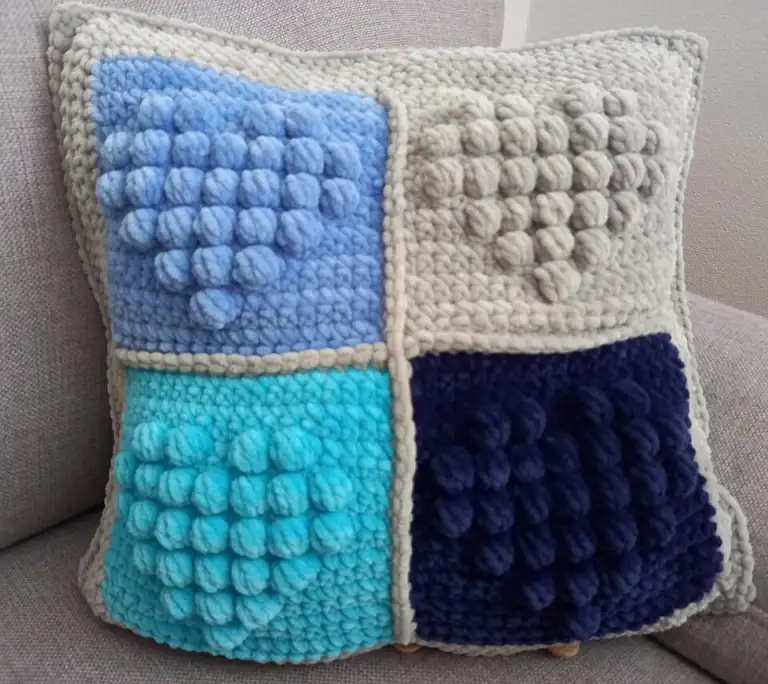
Bobble stitch crochet gives you rows of round, squishy bumps that stand proud of the fabric, and it is much easier than it looks. If you can already make a treble, you can make a bobble today.
Quick answer: To crochet a bobble stitch, work 5 incomplete trebles (UK terms, US double crochet) into the same stitch, then yarn round hook and pull through all 6 loops on the hook. Lock it with a firm double crochet (US single crochet) in the next stitch. Bobbles are usually worked with the wrong side facing so they pop out on the right side.
In this bobble stitch crochet guide we show you how to work a classic 5-treble bobble, why it is worked on wrong-side rows, and how to practise it on a small swatch. We use UK and US terms throughout, with the US name next to each stitch, so the steps make sense wherever you learned to crochet.
What is bobble stitch crochet?
A bobble is a group of unfinished trebles (tr; US double crochet, dc) all worked into the same stitch, then closed together at the top. Because the trebles share one base and one top, the extra yarn has nowhere to go except outwards, so it puffs up into a little ball.
In bobble stitch crochet, those balls sit on a background of short stitches, usually double crochet (dc; US single crochet, sc). The short stitches either side hold the bobble tight and push it to one side of the fabric.
The result is a raised, textured fabric that is lovely for cushions, blankets and hats. You can scatter bobbles in neat lines, stagger them for an all-over texture, or place them carefully to make pictures such as hearts and diamonds.
UK and US terms for bobble stitch crochet
Crochet patterns are written in either UK or US terms, and the same abbreviation can mean a different stitch. This table shows every stitch used in this tutorial.
| UK abbreviation | UK name | US name (US abbreviation) |
|---|---|---|
| ch | chain | chain (ch) |
| ss | slip stitch | slip stitch (sl st) |
| dc | double crochet | single crochet (sc) |
| htr | half treble | half double crochet (hdc) |
| tr | treble | double crochet (dc) |
| dtr | double treble | treble (tr) |
| yrh | yarn round hook | yarn over (yo) |
| B | bobble (5 incomplete tr together) | bobble (5 incomplete dc together) |
If you often switch between pattern styles, keep our UK vs US crochet terms guide handy. The quick test is simple: if a pattern mentions “sc”, it is written in US terms.
What you need
- Yarn: a smooth, light-coloured double knitting (DK) or aran yarn. Plain colours show bobble stitch crochet best.
- Hook: the size suggested on your yarn band, usually 4mm for DK or 5mm for aran.
- Scissors and a tapestry needle for weaving in ends.
- Stitch markers (optional) to mark where each bobble goes.
Before you start, it helps to be comfortable with the UK treble crochet stitch, because every bobble is built from trebles that you stop part-way through.
How to make a bobble stitch: step by step
Here is the standard 5-treble bobble used in most bobble stitch crochet patterns. We describe it in UK terms, so “treble” means a US double crochet. Work it on a wrong-side row, in the stitch where the pattern says “B”.
- Start the first treble. Yarn round hook, insert the hook into the stitch, yarn round hook and pull up a loop. You now have 3 loops on the hook.
- Stop half-way. Yarn round hook and pull through 2 loops only. You have 2 loops on the hook. This is an incomplete treble.
- Repeat in the same stitch. Yarn round hook, insert into the same stitch, yarn round hook, pull up a loop, yarn round hook, pull through 2 loops. You now have 3 loops on the hook.
- Keep going. Make 3 more incomplete trebles in the same stitch. After the fifth one you will have 6 loops on the hook (1 loop from each treble plus the loop you started with).
- Close the bobble. Yarn round hook and pull through all 6 loops on the hook. The trebles gather together at the top.
- Lock it in place. Work the next double crochet (US single crochet) firmly into the next stitch. This pulls the top of the bobble closed. Some patterns add 1 chain after closing the bobble; only do this if your pattern says so, because it adds an extra stitch.
That is one finished bobble. When you look at the side facing you, it looks fairly flat. Turn the work over and you will see the round bobble on the other side, which is exactly what we want.
Why bobble stitch crochet is worked on wrong-side rows
Trebles are much taller than the double crochet around them. When a tall cluster is squashed between short stitches, it bends away from you and bulges out of the back of the work.
That is why bobble stitch crochet patterns place the bobbles on wrong-side rows. The bobble pops out towards the back, which is the right side. The next row, a plain right-side row of double crochet, holds everything in place.

Bobble vs popcorn vs puff vs cluster stitch
Bobble stitch crochet is often confused with popcorn, puff and cluster stitches, because they all gather several loops together. The difference is in which stitches you use and how you close them.
| Stitch | How it is made | How it looks |
|---|---|---|
| Bobble | Several incomplete trebles (US dc) in the same stitch, closed with one yrh through all loops. | Round, soft bump that pops to the other side of the work. |
| Popcorn | Several complete trebles (US dc) in the same stitch. Take the hook out of the last loop, insert it into the first treble, pick up the dropped loop and pull it through. | Firmer, more defined bump that pops towards you, on the side facing you. |
| Puff | Several half-finished loops like a half treble (US hdc): yrh, insert, pull up a long loop, repeated in the same stitch, then yrh and pull through all loops. | Softer, flatter, oval puff with no “legs” of trebles. |
| Cluster | Several incomplete stitches worked into different stitches (or spaces) and closed together at the top. | A fan or V-shape that draws stitches together, often used as a decrease or in lace. |
A neat way to remember it: a bobble is really a cluster where every leg goes into the same stitch. A popcorn uses finished stitches, so it is the sturdiest. A puff uses loops instead of trebles, so it is the softest.
Bobble stitch crochet practice swatch
A small swatch is the best way to learn the rhythm of bobble stitch crochet. This one has staggered bobbles, so you practise both the bobble and the plain rows that hold it in place.
Stitch multiple: multiple of 4 stitches plus 3, plus 1 chain for turning. For the swatch below, make 20 chains.
Notes: the ch 1 at the start of each row does not count as a stitch. The top of each bobble counts as 1 stitch. Row 1 is the right side.
Foundation: Ch 20.
Row 1 (RS): 1 dc (US sc) in 2nd ch from hook and in each ch to end, turn. (19 dc)
Row 2 (WS): Ch 1, 1 dc in each of first 3 sts, *B in next st, 1 dc in each of next 3 sts; rep from * to end, turn. (4 bobbles, 19 sts)
Row 3 (RS): Ch 1, 1 dc in each st to end, working 1 dc into the top of each bobble, turn. (19 dc)
Row 4 (WS): Ch 1, 1 dc in first st, *B in next st, 1 dc in each of next 3 sts; rep from * to last 2 sts, B in next st, 1 dc in last st, turn. (5 bobbles, 19 sts)
Row 5 (RS): As Row 3.
Repeat Rows 2 to 5 twice more, then fasten off. You will have a small square of bobble stitch crochet with staggered bobbles that sit between each other like a honeycomb.

Checking your bobble stitch crochet swatch
- Count to 19 stitches at the end of every row. If you have 20, you have probably worked into the ch 1 at the start of a row.
- Look at the right side. All the bobbles should bulge towards you. If some are flat, they were probably worked on a right-side row.
- The edges should be straight. If they slope, check the first and last stitch of each row.
A simple bobble heart, described in words
Once your swatch is going well, use bobble stitch crochet to draw a picture. A heart is a classic first motif and works on a cushion square or a blanket panel.
Draw it on squared paper first. Each square is one stitch and each row of squares is one row of crochet. Mark bobbles only on wrong-side rows, and leave a plain right-side row of double crochet (US single crochet) between every bobble row.
To keep the bobbles from crowding, place them on every other stitch with 1 dc between, and shift the positions by one stitch on each new bobble row. Reading from the bottom of the heart upwards, the bobble rows could hold:
- 1 bobble in the centre (the point of the heart)
- 2 bobbles
- 3 bobbles
- 4 bobbles
- 5 bobbles (the widest row)
- 4 bobbles
- 2 bobbles, a gap in the middle, then 2 more bobbles (the two rounded tops)
Work a border of plain stitches around the heart, at least 6 stitches each side and 4 rows above and below, so the motif has room to stand out. Check your drawing before you start, and count carefully on every wrong-side row.
The same idea gives you diamonds, stripes and simple letters. Simple lines of bobbles also look lovely along the edge of a project; our crochet blanket border guide shows ways to finish edges neatly.
Tension tips for even bobbles
Bobble stitch crochet uses a lot of yarn, so small changes in tension show clearly. These habits help every bobble look the same size.
- Pull each loop to the same height. When you pull up a loop for each treble, lift it to roughly the height of a normal treble. Short loops give tight, small bobbles.
- Do not yank the closing loop. Pull through all 6 loops smoothly. A very hard tug can split the yarn or distort the top.
- Keep the next stitch firm. The double crochet (US single crochet) after the bobble should be snug, as it holds the bobble closed.
- Keep the background a little tight. If the plain rows are loose, the bobbles sink into the fabric. Some crocheters go down half a hook size for the whole piece.
- Use your finger. After each bobble row, you can gently push each bobble through to the right side with a fingertip so it sits neatly.
Bobble stitch crochet for left-handed crocheters
Left-handed crocheters work exactly the same bobble; you simply hold the hook in your left hand and work from left to right along the row. The stitch counts in the swatch stay the same, so any bobble stitch crochet pattern works for you.
The main difference is pictures. A charted motif worked left-handed comes out as a mirror image. A heart or diamond is symmetrical, so it looks the same, but letters and numbers will be back to front. Flip your drawing on squared paper before you start.

When you follow a photo tutorial made for right-handers, it can help to hold a small mirror next to the picture, or flip the image on your phone, so the hands match yours.
Common bobble stitch crochet mistakes and how to fix them
Most bobble stitch crochet problems come down to stitch counts or tension. Here are the ones we see most often.
The bobbles are flat
This usually means the bobbles were worked on right-side rows, or the stitches either side are too loose. Check that every bobble row is a wrong-side row, and tighten the double crochet next to each bobble.
There are too many loops on the hook
If you have more than 6 loops, you probably skipped the “pull through 2” step on one treble. If you have fewer, you may have finished a treble completely. Count as you go: 2, 3, 4, 5, 6.
The fabric is getting wider
Adding an extra chain after the bobble, or working into the turning chain, adds stitches. Only add a chain after a bobble if the pattern tells you to, and count your stitches at the end of every row.
Holes appear next to the bobbles
Small gaps beside bobbles are normal, but big holes usually mean loose plain stitches. Try a smaller hook for the background rows, or pull the double crochet after each bobble more snugly.
I cannot find the top of the bobble
On the next right-side row, the top of each bobble looks like a slightly tighter “V”. It counts as 1 stitch. Work 1 double crochet into it and carry on.
Choosing yarn and hook for bobble stitch crochet
Bobble stitch crochet shows up best in smooth yarn with good stitch definition. Cotton and cotton blends give crisp, round bobbles. Acrylic and wool blends give softer, squishier bobbles that are lovely for blankets.
Fluffy, hairy or very dark yarns hide the texture, so save them for later projects. Variegated yarns can work, but plain colours make the bobbles the star.
DK and aran weights are the easiest to learn with. If you are unsure what the weight names mean, the Craft Yarn Council yarn weight system explains the categories and suggested hook sizes.
Because bobbles eat yarn, bobble stitch crochet uses noticeably more yarn than plain double crochet of the same size. Buy enough from the same dye lot so the colour matches all the way through.
Bobble stitch crochet project ideas
Bobble stitch crochet adds texture and a handmade feel to all kinds of projects. Here are some easy places to start.
- Cushion cover: work two squares in double crochet (US single crochet), with a bobble heart or diamond on the front panel, then join them around three sides and slip in a cushion pad.
- Blanket: add rows of bobbles between plain stripes, or make a set of squares with different bobble motifs. Our easy crochet blanket pattern is a good base for this.
- Hat: work a band of bobbles around the brim of a simple hat. Try our crochet hat pattern and add one bobble round near the bottom. If the hat is worked in joined rounds, turn before the bobble round so the wrong side faces you, then turn back for the next round, so the bobbles pop outwards.
- Edging: a row of bobbles spaced along an edge makes a simple, cheerful trim for blankets and scarves.

If you are starting a project in the round, a crochet magic ring gives a neat, closed centre, and a slip stitch joins each round tidily.
Other stitches to try after bobbles
Once bobble stitch crochet feels comfortable, try varying the height and number of stitches in each bobble.
- A smaller bobble uses 3 or 4 incomplete trebles instead of 5.
- A taller bobble can be made from incomplete double trebles (US treble crochet), closed in the same way.
- A puff stitch uses half treble (US half double crochet) style loops for a softer texture.
Always make a small test swatch when you change the bobble size, as it changes how much yarn each row uses and how the fabric lies.
Bobbles look gorgeous on a crochet cushion, especially worked in heart shapes.
Frequently asked questions about bobble stitch crochet
How many stitches are in a crochet bobble?
The most common bobble uses 5 incomplete trebles (US double crochet) in one stitch, but 3, 4 or 6 are also used. Always follow the number given in your pattern.
Why do my bobbles appear on the wrong side?
Bobbles pop out on the side facing away from you. Work them on wrong-side rows, between short stitches such as double crochet (US single crochet), and they will appear on the right side.
What is the difference between a bobble and a popcorn stitch?
A bobble is made from incomplete trebles closed together at the top. A popcorn is made from complete trebles, then the first and last are joined by dropping the loop and pulling it through the first treble, which makes a firmer bump.
Does a bobble count as a stitch?
Yes. The top of each bobble counts as 1 stitch, so on the next row you work 1 stitch into it to keep your stitch count the same.
Is bobble stitch crochet good for beginners?
Yes, once you can make a treble and a double crochet. Start with a small swatch in smooth, light-coloured yarn so you can see each bobble clearly and count your loops.