A crochet bib is one of the most useful things you can make for a baby. Babies get through several bibs a day, so a soft cotton bib that washes well is always welcome, and it is a lovely small project to add to a baby shower gift.
This page has two free crochet bib patterns in UK terms with US conversions: a classic baby bib with neck straps that fasten with a popper or button, and a quick bandana bib. Both are worked flat in half treble crochet, take one or two hours, and come with stitch counts, a diagram and baby safety tips.
Quick answer: To crochet a bib, chain 26 and work rows of half treble crochet, increasing 1 stitch at each end of rows 2 and 3 to 28 stitches. Work 16 rows, then make two 5-stitch neck straps of 14 rows, leaving 18 stitches for the neckline. Add a round of double crochet edging and a popper. Use 40g of DK cotton and a 4mm hook; it takes 1 to 2 hours.
Why make a crochet baby bib?
- Quick to finish. A crochet bib takes 1 to 2 hours, so you can make a set of three in an evening or two.
- Uses little yarn. One 50g ball of cotton makes a whole bib.
- Absorbent and washable. Cotton half trebles make a thick, soft fabric that soaks up dribble and copes with hot washes.
- Beginner friendly. Both bibs are worked in rows with simple increases, so they are a good first baby project.
The bibs use half treble crochet. If you need a refresher, see our half treble crochet guide, and our UK vs US crochet terms chart if you usually follow US patterns.
What you need
| Item | What to use |
|---|---|
| Yarn | DK (light worsted) 100% cotton: about 40g for the baby size, 55g for the toddler size |
| Hook | 4mm (UK 8, US G-6) |
| Fastening | 1 plastic press stud (popper) or 1 flat button, 12 to 15mm |
| Extras | Tapestry needle, scissors, stitch marker |
Choose 100% cotton for a crochet bib. It is absorbent, it does not pill, and it can be washed at 40 or 60 degrees. Acrylic is not absorbent, so it is not a good choice for bibs. DK is weight 3 (light) in the Craft Yarn Council yarn weight system.
Abbreviations (UK terms)
| UK term | US term | Meaning |
|---|---|---|
| ch | ch | chain |
| dc | sc | double crochet (US single crochet) |
| htr | hdc | half treble crochet (US half double crochet) |
| sl st | sl st | slip stitch |
| sk | sk | skip |
| st(s) | st(s) | stitch(es) |
Tension and sizes
16 htr and 12 rows = 10cm on a 4mm hook. Tension is not critical for a bib, but a firm fabric is more absorbent and keeps its shape better.
| Size | Bib width | Bib length (without straps) | Yarn |
|---|---|---|---|
| Baby (0 to 12 months) | 17.5cm | 13cm | 40g |
| Toddler (1 to 3 years) | 21cm | 17cm | 55g |
Instructions are written for the baby size, with the toddler size in brackets.
How the crochet bibs are shaped
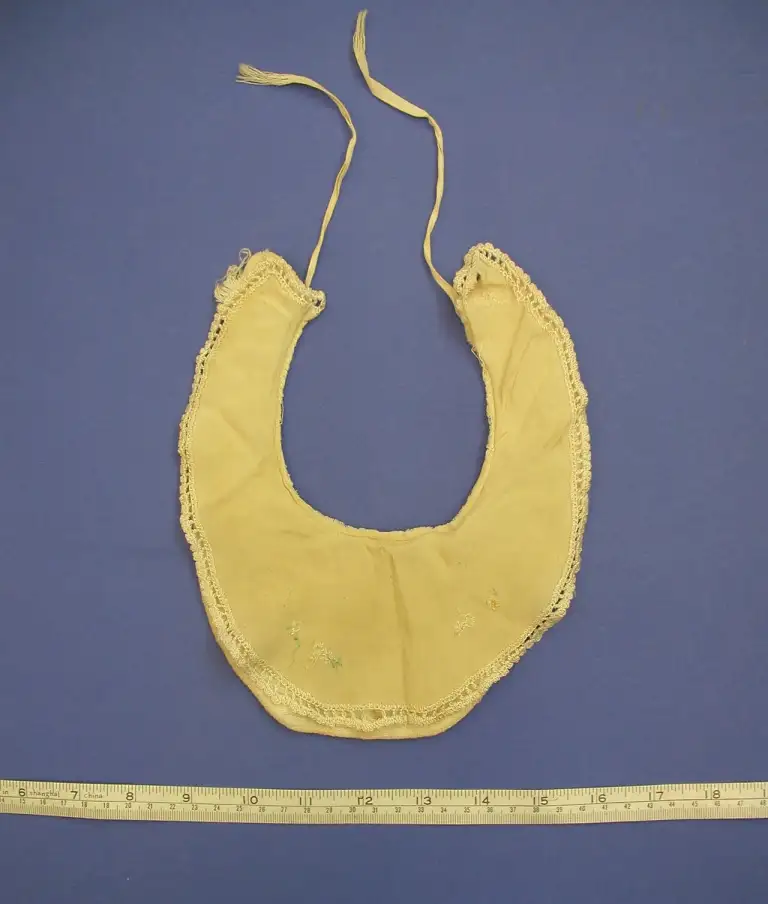
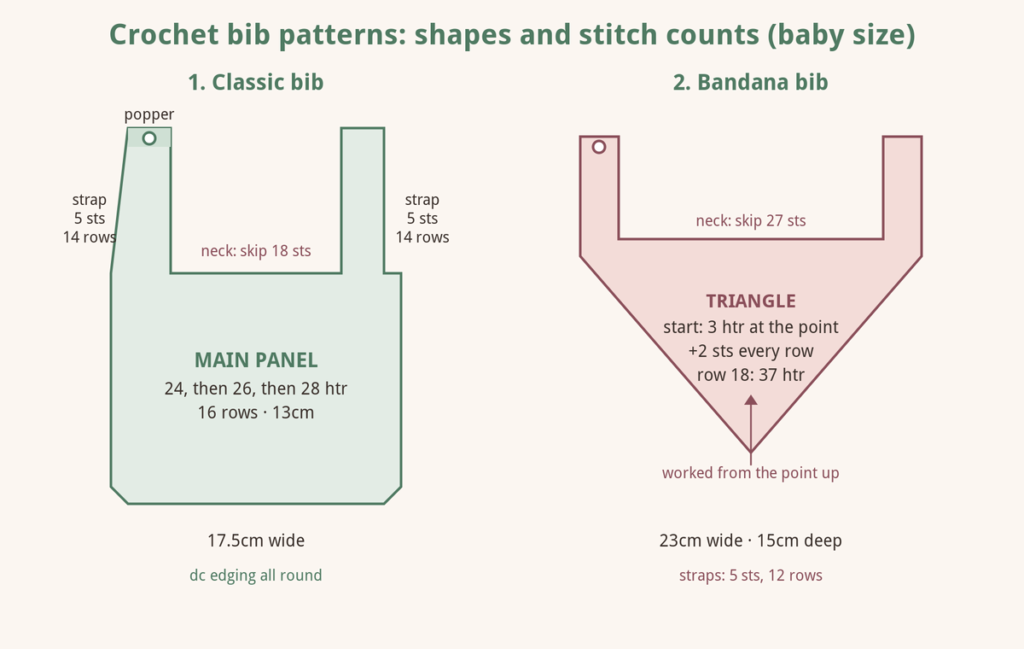
The diagram shows both bibs. The classic bib is a wide panel with two narrow straps that go round the back of the neck and fasten with a popper. The bandana bib is a triangle worked from the point upwards.
Pattern 1: classic crochet baby bib
Main panel
Ch 26 (32).
Row 1: 1 htr in the 3rd ch from hook (the skipped ch do not count as a st) and in each ch to end, turn. 24 (30) htr.
Row 2: Ch 2 (does not count as a st), 2 htr in the first st, 1 htr in each st to the last st, 2 htr in the last st, turn. 26 (32) htr.
Row 3: Repeat row 2. 28 (34) htr.
Row 4: Ch 2, 1 htr in each st to end, turn. 28 (34) htr.
Repeat row 4 until you have 16 (20) rows in total. The panel should measure about 13 (17)cm from the bottom edge.
Neck straps
First strap: Ch 2, 1 htr in each of the first 5 (6) sts, turn, leaving the rest unworked. Work 13 (15) more rows of htr on these 5 (6) sts, so the strap has 14 (16) rows and measures about 11.5 (13)cm. Fasten off.
Second strap: Skip the next 18 (22) sts for the neckline. Join the yarn in the next st, ch 2, 1 htr in each of the last 5 (6) sts, turn. Work 13 (15) more rows of htr, making a buttonhole on the second-to-last row if you are using a button: ch 2, 2 htr, ch 1, sk 1 st, 2 (3) htr, turn. On the last row, work 1 htr into the ch-1 space. Fasten off.
Edging
Join the yarn at the bottom corner. Ch 1, work 1 round of dc evenly all the way round the bib, including up and down both straps and around the neckline. Work 3 dc into each corner so the edge lies flat, and about 1 dc for every row end along the sides. Sl st to the first dc and fasten off.
Finishing
Try the straps round the back of a teddy or a soft toy of a similar size, overlapping the ends by about 2cm. Fix the two halves of the press stud to the strap ends, or sew a button opposite the buttonhole. Weave in all the ends securely.
Pattern 2: crochet bandana bib
A bandana bib is a triangle that sits like a little scarf. It is quick, very cute and especially good for teething babies, as it catches dribble without looking like a bib. This version is the baby size.
Row 1: Ch 2, 3 htr in the 2nd ch from hook, turn. 3 htr.
Row 2: Ch 2, 2 htr in the first st, 1 htr in each st to the last st, 2 htr in the last st, turn. 5 htr.
Rows 3 to 18: Repeat row 2, adding 2 sts on every row. At the end of row 18 you will have 37 htr.
Straps: Ch 2, 1 htr in each of the first 5 sts, turn, and work 11 more rows on these 5 sts. Fasten off. Skip the middle 27 sts, join the yarn in the next st and work the second strap on the last 5 sts in the same way, adding a buttonhole on the second-to-last row if you like.
Edging: work 1 round of dc all the way round as for the classic bib, with 3 dc in the point of the triangle. Add a popper or button to the straps.
Safety tips for crochet bibs
- Use a popper or button, not long ties. Ties around a baby’s neck can be dangerous. Short straps with a press stud come apart if they are pulled.
- Always take the bib off before a baby sleeps or naps, and never leave a baby unattended in a bib.
- Fix fastenings firmly. Use a press stud tool, or sew buttons with doubled thread, and check them before each use.
- No decorations. Skip beads, sequins and small appliqués on anything a baby could chew.
Ideas for your crochet bibs
- Stripes: change colour every 2 rows for a cheerful striped bib. Carry the yarn up the side so there are fewer ends.
- Contrast edge: work the dc edging in a second colour, or add a shell edge along the bottom only.
- Christmas bib: a red bib with a white edge makes a sweet first Christmas outfit.
- Gift set: make three bibs in coordinating colours and add our easy crochet baby booties and crochet baby hat.
- Outfit: match the bib to our crochet baby dress or crochet baby cardigan.
If you enjoy making flat cotton pieces like this, our crochet coasters are another quick, useful project for leftover cotton.
Common problems and how to fix them
The edges of the bib are wavy
Too many stitches went into the edging. Pull it back and work roughly 3 dc for every 4 row ends along the sides.
The bib curls at the bottom
Your foundation chain is too tight. Use a hook one size larger for the chain only, or block the bib by pinning it flat, spraying it with water and leaving it to dry.
The straps are too short or too long
Every baby is different. Add or remove 2 rows on each strap until they overlap by about 2cm around the neck.
Washing your crochet bib
Cotton bibs can usually go in a 40 or 60 degree wash. Close the press stud first so it does not catch on other clothes, reshape the bib while damp and dry it flat or on a low tumble dry setting.
Frequently asked questions about crochet bibs
Is a crochet bib easy to make?
Yes. Both bibs are worked flat in rows of half treble crochet with simple increases at the start and end of a few rows. They are a good first baby project.
What is the best yarn for a crochet bib?
100% cotton in DK weight. Cotton is absorbent, soft and can be washed hot. Avoid acrylic for bibs, as it does not absorb liquid well.
How much yarn do I need for a crochet bib?
About 40g of DK cotton for the baby size and 55g for the toddler size, so one 50g ball is enough for a baby bib.
How long does it take to crochet a bib?
About 1 to 2 hours for the classic bib and around 1 hour for the bandana bib, including the edging.
Can I make this crochet bib pattern in US terms?
Yes. Use US half double crochet where the pattern says htr and US single crochet where it says dc. The stitch counts stay the same.