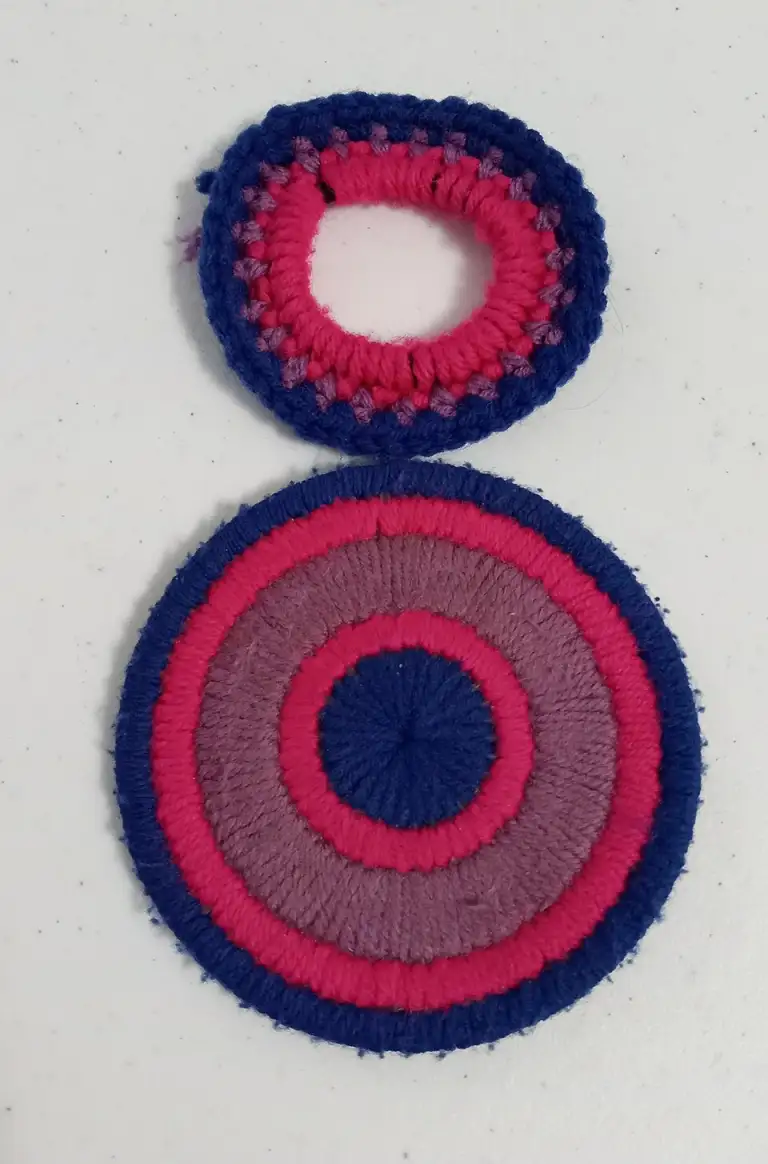
Crochet coasters are one of the most useful small makes you can work up in an evening. They protect your table from hot mugs and drips, they use very little yarn, and a stack of them tied with ribbon makes a lovely handmade present.
Quick answer: Crochet coasters are best made in 100% cotton DK yarn with a 4mm hook, because cotton absorbs drips and does not melt under a hot mug. This page has three free beginner patterns in UK terms: a round half treble coaster, a granny square coaster and a moss stitch square, each about 10cm across and 30 to 60 minutes to make.
There are three different crochet coaster pattern ideas here, all written in UK terms with exact stitch counts: a round half treble coaster worked in joined rounds, a classic granny square coaster, and a flat moss stitch square with a neat border. We also cover choosing cotton yarn, blocking, making a matching set with a simple holder, and gifting.
If you have already tried the quick coaster in our easy crochet gifts roundup, these crochet coasters go further, with three shapes, more detail and tips for a finish that lies really flat.
Why make crochet coasters?
Crochet coasters are small, so you finish one quickly and see your progress straight away. That makes them ideal for practising a new stitch or testing a colour combination before you commit to something bigger, such as a blanket.
They are also genuinely useful. A cotton coaster soaks up condensation from a cold glass and keeps the heat of a mug of tea away from a wooden surface. Unlike paper or cork mats, crochet coasters can go in the wash and come out looking fresh.
- Quick: each one can be finished in a single sitting once you know the pattern.
- Light on yarn: a single ball of DK cotton usually makes several.
- Great for scraps: small amounts of leftover cotton are perfect for centres and borders.
- Easy to gift: a matching set looks thoughtful and posts easily.
What you need for these crochet coasters
All three patterns use the same basic kit, so you can make one of each without buying anything new.
- 100% cotton DK yarn in one or more colours
- A 4mm crochet hook (UK 8, US G-6), plus a 3.5mm hook if you crochet loosely. Our crochet hooks guide explains sizes and styles.
- A yarn needle for weaving in ends
- Scissors
- Rustproof pins and a foam mat or folded towel for blocking
- A stitch marker (optional but handy for rounds)
Check the ball band for the recommended hook. Most DK cottons work well on a 4mm hook, but if your coaster feels loose and floppy, drop down to 3.5mm for a firmer fabric. Coasters work best when the stitches are fairly tight.
Abbreviations (UK terms)
| UK term | Abbreviation | US equivalent |
|---|---|---|
| Chain | ch | Chain |
| Slip stitch | ss | Slip stitch (sl st) |
| Double crochet | dc | Single crochet (sc) |
| Half treble crochet | htr | Half double crochet (hdc) |
| Treble crochet | tr | Double crochet (dc) |
| Stitch(es) / space | st(s) / sp | Stitch(es) / space |
New to UK terms? Our UK vs US crochet terms guide explains why the names differ and how to convert any pattern.
Choosing yarn: why 100% cotton DK is best for crochet coasters
The yarn you choose matters more for crochet coasters than for most projects. A coaster has to cope with heat, moisture and regular washing, and natural cotton handles all three well.
Heat resistance
Cotton is a plant fibre, so it does not melt. Acrylic is a type of plastic and can soften, go shiny or scorch if something very hot sits on it. For a mug of tea or coffee, cotton is the safer choice.
Even so, a coaster is not a trivet. Do not put pans or dishes straight from the hob or oven on crochet coasters, as the fabric is thin and full of tiny gaps that let heat through.
Absorbency
Cotton soaks up water, which is exactly what you want under a cold glass that drips with condensation. Unmercerised cotton is soft and matt and is the most absorbent type.
Mercerised cotton has been treated to give it a gentle sheen. It shows stitches crisply and holds its colour well, but it absorbs a little less. Either works: pick unmercerised for everyday drinks and mercerised if you want a smart, slightly glossy finish for gifts.
Washing
Most cotton yarns can be machine washed, but always follow the care symbols on your ball band. A gentle wash at a low temperature keeps colours bright. Pull each coaster back into shape while damp and dry it flat, away from direct heat.
Cotton can shrink a little the first time it is washed, so if you are making a set to a precise size, wash and dry a test swatch first. Our guide to crochet yarn covers fibres in more detail, and the Craft Yarn Council yarn weight system shows where DK sits among the standard weights.

Pattern 1: round half treble crochet coaster
This first crochet coaster pattern makes a solid circle about 10cm across. It is worked in joined rounds, so each round ends with a slip stitch and the next begins with a short chain. That gives a tidy, even edge.
It starts with a magic ring, which closes the centre completely. If you have never made one, follow our step by step how to do a crochet magic ring tutorial first. If you need a refresher on the main stitch, see our half treble crochet guide.
Pattern notes
- The ch2 at the start of each round does not count as a stitch.
- Join each round with a ss into the first htr, not into the ch2.
- Each round adds 12 stitches. Count at the end of every round.
- A stitch marker in the first htr of each round makes the join easy to find.
Round coaster instructions
Round 1: Make a magic ring. Ch2 (does not count as a st), 12 htr into the ring. Pull the tail to close the ring and ss to the first htr to join. (12 sts)
Round 2: Ch2, 2 htr in each st around. Ss to the first htr. (24 sts)
Round 3: Ch2, *htr in the next st, 2 htr in the next st; rep from * 11 more times. Ss to the first htr. (36 sts)
Round 4: Ch2, *htr in the next 2 sts, 2 htr in the next st; rep from * 11 more times. Ss to the first htr. (48 sts)
Round 5: Ch2, *htr in the next 3 sts, 2 htr in the next st; rep from * 11 more times. Ss to the first htr. (60 sts)
Round 6 (edging): Ch1 (does not count as a st), dc in each st around. Ss to the first dc. (60 sts) Fasten off.
The finished coaster should measure roughly 10cm across. Weave in the ends on the back, then block it flat as described further down.
If the circle ruffles or cups
A circle that ripples like a frill usually means your stitches are a little loose for the yarn, so try a smaller hook. A circle that curls up into a bowl usually means your tension is tight, so go up half a size. Check your stitch count too, as one missed increase is enough to make it cup.
Increases stacked in the same place can make a circle look slightly hexagonal. To round it off, start the repeat with the increase on Rounds 4 and 5 instead (for example, *2 htr in the next st, htr in the next 2 sts*). The stitch counts stay exactly the same.

Pattern 2: granny square coaster
Granny squares make classic crochet coasters, and they are perfect for using up small amounts of colour. This version is four rounds of treble groups plus a double crochet border, for a finished square about 10cm across.
For more practice with the main stitch, our treble crochet guide walks through it step by step.
Granny coaster notes
- The ch3 at the start of a round counts as the first tr.
- Corner spaces are ch2; side spaces are ch1.
- Work every round with the right side facing; do not turn.
- To change colour, fasten off at the end of a round, join the new colour with a ss in any corner space and carry on from the ch3.
Granny square coaster instructions
Round 1: Make a magic ring. Ch3 (counts as first tr), 2 tr into the ring, ch2, *3 tr into the ring, ch2; rep from * twice more. Pull the ring closed and ss to the top of the ch3. (12 tr, 4 ch-2 corner sps)
Round 2: Ss in the next 2 tr and into the ch-2 corner sp. Ch3, (2 tr, ch2, 3 tr) in the same corner sp. *Ch1, (3 tr, ch2, 3 tr) in the next corner sp; rep from * twice more. Ch1 and ss to the top of the ch3. (24 tr in 8 groups, 4 corner sps, 4 ch-1 sps)
Round 3: Ss in the next 2 tr and into the corner sp. Ch3, (2 tr, ch2, 3 tr) in the same sp. *Ch1, 3 tr in the next ch-1 sp, ch1, (3 tr, ch2, 3 tr) in the next corner sp; rep from * twice more. Ch1, 3 tr in the next ch-1 sp, ch1, ss to the top of the ch3. (36 tr in 12 groups)
Round 4: Ss in the next 2 tr and into the corner sp. Ch3, (2 tr, ch2, 3 tr) in the same sp. *[Ch1, 3 tr in the next ch-1 sp] twice, ch1, (3 tr, ch2, 3 tr) in the next corner sp; rep from * twice more. [Ch1, 3 tr in the next ch-1 sp] twice, ch1, ss to the top of the ch3. (48 tr in 16 groups)
Round 5 (border): Ch1 (does not count as a st). Dc in the same st as the join, then dc in each tr and each ch-1 sp around, working 3 dc into each ch-2 corner sp. Ss to the first dc. (72 dc: 15 dc along each side plus 3 dc at each corner) Fasten off.
Colour ideas for granny crochet coasters
Try a different centre colour on every coaster with the same border colour, so the set looks planned. Or work Rounds 1 and 2 in one shade and Rounds 3 to 5 in another for a simple two-tone look.
A cream or white border makes bright centres pop, while a dark border gives a more modern feel. Granny squares often twist a little as you work; blocking straightens them out.
Pattern 3: moss stitch square coaster
The third design is worked in flat rows. Moss stitch (also called linen stitch or granite stitch) alternates double crochet and single chains, creating a dense, woven-looking fabric that lies beautifully flat.
It is a smart choice for crochet coasters because the texture is firm under a mug and shows off variegated or speckled cotton well. It only uses chains and double crochet, so it is ideal for beginners.
Moss stitch notes
- In moss stitch you work each dc into a ch-1 space of the row below and skip the dc stitches.
- The ch1 at the start of each row is a turning chain and does not count as a stitch.
- Every row has 17 stitches if you count each dc and each ch-1 sp as one stitch.
- The first and last stitch of every row is always a dc, which keeps the edges straight.
Moss stitch coaster instructions
Foundation: Ch18.
Row 1: Dc in the 2nd ch from the hook and in each ch to the end. Turn. (17 dc)
Row 2: Ch1, dc in the first st, *ch1, skip the next st, dc in the next st; rep from * to the end. Turn. (9 dc, 8 ch-1 sps)
Row 3: Ch1, dc in the first dc, dc in the next ch-1 sp, *ch1, skip the next dc, dc in the next ch-1 sp; rep from * until 1 dc remains, dc in the last dc. Turn. (10 dc, 7 ch-1 sps)
Row 4: Ch1, dc in the first dc, *ch1, skip the next dc, dc in the next ch-1 sp; rep from * until 2 dc remain, ch1, skip the next dc, dc in the last dc. Turn. (9 dc, 8 ch-1 sps)
Rows 5 onwards: Repeat Rows 3 and 4 until the piece is square, ending with a Row 4. This is usually around 18 to 20 rows in total, but measure rather than count, as row height varies with tension. Do not fasten off.
Border Round 1: Ch1 and turn. 3 dc in the first st, dc in each st and ch-1 sp across until 1 st remains, 3 dc in the last st. Working down the side, space 15 dc evenly into the row ends. Working along the foundation chain, 3 dc in the first ch, dc in each of the next 15 ch, 3 dc in the last ch. Work 15 dc evenly up the second side. Ss to the first dc. (72 dc)
Border Round 2 (optional): Ch1, dc in each st around, working 3 dc into the centre dc of each 3-dc corner. Ss to the first dc. (80 dc) Fasten off.
With one border round the coaster is roughly 9 to 10cm square; the second round takes it to about 10 to 11cm. A contrast colour on the final round looks very smart.
Tips for neat edges
Row ends are the trickiest part of bordering square crochet coasters. If a side ripples, you have too many stitches, so skip a row end here and there. If it pulls in, add one. Keeping 15 dc on every side between the corners keeps the square even.
Blocking crochet coasters so they lie flat
Blocking is the step that turns a slightly wavy circle or square into a crisp, flat coaster. It is quick, and cotton blocks very well.
- Wet: soak the coaster in cool water, squeeze out the excess gently (do not wring) and roll it in a towel. Or pin it dry and spray it with water.
- Pin: lay it on a foam mat or folded towel and pin to shape with rustproof pins. Use a ruler so every coaster in a set ends up the same size. For squares, pin the corners first, then the middle of each side.
- Dry: leave it flat until it is completely dry, then unpin.
Cotton crochet coasters also tolerate steam. Hold a steam iron just above the pinned coaster without pressing down, then let it cool and dry before moving it. Avoid steaming acrylic, as heat can relax it permanently and leave it limp.

Making a set of crochet coasters
Crochet coasters are usually given in sets of four or six. A few simple habits make sure every one matches:
- Use the same hook and the same yarn throughout, ideally from the same dye lot.
- Write down any change you make, such as a smaller hook or an extra round, so every coaster gets it.
- Measure each coaster after blocking and compare it with the first one.
- Weave in ends in the same way on each, so the backs look tidy too.
You can also mix the three designs in one colour palette: two round, two granny and two moss stitch, all finished with the same border colour. The shapes differ, but the shared colours tie the set together.

A simple matching coaster holder
A small round basket makes a neat home for a stack of crochet coasters. It uses the same yarn and hook, and the base is simply the round coaster pattern with one more increase round.
Base: Work Rounds 1 to 5 of the round coaster pattern. Then work one more round: Ch2, *htr in the next 4 sts, 2 htr in the next st; rep from * 11 more times. Ss to the first htr. (72 sts)
Turning round: Ch1, dc in the back loop only of each st around. Ss to the first dc. (72 sts) Working into the back loops makes the sides stand up.
Sides: Ch1, dc in each st around, ss to the first dc. (72 sts) Repeat this round until the sides are about 4cm tall, then fasten off.
This size suits round crochet coasters. Square ones need more room for their corners, so before the turning round add two more increase rounds (htr in the next 5 sts, 2 htr in the next, then htr in the next 6 sts, 2 htr in the next) for 96 sts, and keep 96 sts for the sides. Always test the fit before you fasten off.
Gifting crochet coasters
A set of handmade crochet coasters is a thoughtful present for a housewarming, a teacher or a new neighbour. They are light, flat and easy to post in a card-backed envelope.
- Tie a stack with ribbon or baker’s twine, or present them in the matching holder.
- Add a small care label: “100% cotton. Gentle wash, reshape and dry flat.”
- Pair the crochet coasters with a favourite mug, a packet of tea or coffee, or a handwritten card.
- Choose colours that suit the recipient’s kitchen or living room.
Coasters in red, green and cream make quick festive presents and stocking fillers; our Christmas crochet ideas has plenty more seasonal inspiration. For other fast makes, browse our small crochet projects.
Common problems with crochet coasters and how to fix them
| Problem | Likely cause | Fix |
|---|---|---|
| Round coaster cups into a bowl | Missed increase or tight tension | Recount each round; try a hook half a size larger |
| Round coaster ruffles | Extra stitches or loose tension | Recount each round; try a smaller hook |
| Granny square twists | Normal for granny squares | Block it flat, pinning the corners square |
| Moss square edges slant or wobble | First or last dc missed on a row | Check every row starts and ends with a dc |
| Coaster feels thin and floppy | Hook too large for the yarn | Drop to a 3.5mm hook |
| Hole in the centre | Magic ring not pulled tight | Close the ring firmly and weave the tail in securely |
Next home project: an easy crochet cushion cover in half treble crochet.
Frequently asked questions about crochet coasters
What size should crochet coasters be?
Around 10cm across or square is a good standard size. It sits comfortably under most mugs and glasses without taking up too much table space.
Can I use acrylic yarn for crochet coasters?
You can for purely decorative pieces, but 100% cotton is better for drinks. Acrylic can soften or scorch under very hot mugs, while cotton copes with warmth and absorbs drips.
How much yarn do crochet coasters need?
Very little. A single 50g ball of DK cotton is usually enough for several coasters, depending on the size and border. Leftover scraps are perfect for granny square centres.
How do I wash crochet coasters?
Follow the care symbols on your ball band. Most cotton can be machine washed on a gentle, low-temperature cycle. Reshape each coaster while damp and dry it flat.
Which crochet coaster pattern is best for beginners?
The moss stitch square, as it uses only chains and double crochet worked in rows. The round half treble coaster is a good next step for learning to work in joined rounds.
Ready to make your crochet coasters?
Start with whichever shape appeals most, then try the other two once you have the hang of it. A single crochet coaster pattern repeated in different colours makes a lovely set, and mixing all three gives a cheerful, coordinated look.
Once you have made one set of crochet coasters, you may find yourself making them for everyone you know. Happy hooking!