UK vs US crochet terms are the single biggest reason a pattern turns out the wrong size, shape or texture. Have you ever followed a pattern for a cosy winter beanie, only to end up with an enormous floppy sack twice the intended height? Or tried making a delicate lace shawl and ended up with a stiff placemat?
Quick answer: UK and US crochet terms use the same names for different stitches. UK double crochet (dc) is US single crochet (sc), UK half treble (htr) is US half double crochet (hdc), UK treble (tr) is US double crochet (dc) and UK double treble (dtr) is US treble (tr). Chain and slip stitch are the same in both, so check which terms a pattern uses before you start.
Nine times out of ten, the culprit is terminology confusion between British and American crochet conventions.
Because both traditions use identical words like double crochet and treble to describe completely different heights of stitches, knowing how to convert them is one of the most useful skills any crocheter can learn. This guide to UK vs US crochet terms covers the full stitch chart, abbreviations, hook sizes, yarn weights and a simple method for converting any pattern.
Why UK vs US crochet terms are different
Both systems name stitches by counting, but they count different things. That is the whole secret, and once it clicks, the rest of this guide makes sense.
In UK terms, the name comes from the number of loops on your hook once you have pulled up the first loop through the stitch. For a UK double crochet you insert the hook, pull up a loop and have two loops on the hook, so it is a ‘double’. For a UK treble you wrap the yarn round the hook first, so you have three loops on the hook, hence ‘treble’.
In US terms, the name comes from how many times you yarn over and pull through two loops to finish the stitch. The US single crochet is finished in one step, so it is ‘single’. The US double crochet takes two steps, so it is ‘double’.
The result is that the same stitch has two different names, and the same name points to two different stitches. Neither system is wrong. They simply grew up separately, and pattern writers on each side of the Atlantic have kept their own conventions ever since.
The one-step rule
The easiest way to remember UK vs US crochet terms is the one-step rule. A UK stitch name is always one step ‘taller’ in name than its US twin:
- UK double crochet (dc) = US single crochet (sc)
- UK half treble (htr) = US half double crochet (hdc)
- UK treble (tr) = US double crochet (dc)
- UK double treble (dtr) = US treble (tr)
- UK triple treble (trtr) = US double treble (dtr)
Chain and slip stitch are the same stitch in both systems. Only the abbreviation for slip stitch changes: UK patterns usually write ss, while US patterns write sl st.
So when you read a US pattern, move each stitch name up one step to find the UK stitch. When you read a UK pattern as an American crocheter, move each name down one step.
UK vs US crochet terms conversion chart
Keep this quick reference to UK vs US crochet terms bookmarked whenever you begin a new project from an international magazine or designer:
UK vs US crochet terms
Quick translation chart so you never work the wrong stitch height
| UK term | UK abbr. | US equivalent | US abbr. | Height |
|---|---|---|---|---|
| Slip stitch | ss | Slip stitch | sl st | Flat |
| Double crochet | dc | Single crochet | sc | Short (about 1 ch) |
| Half treble crochet | htr | Half double crochet | hdc | Medium (about 2 ch) |
| Treble crochet | tr | Double crochet | dc | Tall (about 3 ch) |
| Double treble crochet | dtr | Treble (triple) crochet | tr | Extra tall (about 4 ch) |
| Triple treble crochet | trtr | Double treble crochet | dtr | Very tall (about 5 ch) |
If you are new to the taller stitches, our step-by-step guides to the half treble crochet, the treble crochet and the double treble crochet all use UK terms with the US names alongside.
UK vs US crochet terms for abbreviations and pattern language
Stitch names are only half the story. The words around them change too, and a few of them can trip you up if you are not expecting them. Here are 12 of the most useful UK vs US crochet terms to know:
| UK term | US term | Notes |
|---|---|---|
| chain (ch) | chain (ch) | Same in both |
| slip stitch (ss) | slip stitch (sl st) | Same stitch, different abbreviation |
| double crochet (dc) | single crochet (sc) | The shortest basic stitch |
| half treble (htr) | half double crochet (hdc) | Sits between the two |
| treble (tr) | double crochet (dc) | The classic granny square stitch |
| double treble (dtr) | treble or triple crochet (tr) | A tall, open stitch |
| triple treble (trtr) | double treble (dtr) | Very tall, often used in lace |
| dc2tog | sc2tog | A simple decrease |
| tr2tog | dc2tog | Same letters, different stitch |
| yarn round hook (yrh) | yarn over (yo) | Same action |
| miss | skip | Same meaning |
| tension | gauge | Stitches and rows per 10cm or 4in |
Decreases are where UK vs US crochet terms cause the most trouble. A UK pattern that says dc2tog means two short stitches worked together, but a US pattern that says dc2tog means two tall stitches worked together. Mixing them up changes both the height and the shape of your work.
Some words are shared. ‘Fasten off’, ‘turn’ and ‘right side’ mean the same thing in both countries. A ‘tension square’ in the UK is a ‘gauge swatch’ in the US, and both are there to check your stitch size before you start.

Hook size conversion chart: metric, UK old gauge and US
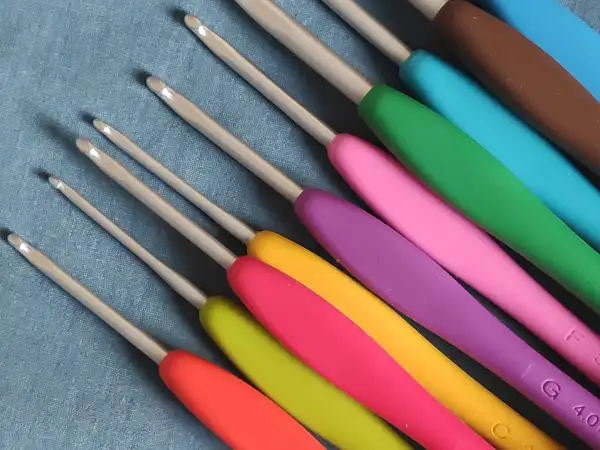
Hook sizes are not strictly part of UK vs US crochet terms, but they cause just as much confusion. Before metric sizing became standard across the UK and Europe, British hooks were numbered using an old imperial system where smaller numbers meant thicker hooks. You will still see these numbers in vintage patterns and on older hooks. Here is the modern mapping:
| Metric (mm) | UK Imperial (Old) | US Letter / Number | Recommended Use |
|---|---|---|---|
| 2.25 mm | UK 13 | US B-1 | Lace & Crochet Thread |
| 2.75 mm | UK 12 | US C-2 | Fine 4-ply / Baby Lace |
| 3.25 mm | UK 10 | US D-3 | 4-ply / Sock Yarns |
| 3.50 mm | UK 9 | US E-4 | Firm DK / Amigurumi |
| 4.00 mm | UK 8 | US G-6 | Standard DK (Double Knitting) |
| 4.50 mm | UK 7 | US 7 | Heavy DK / Light Aran |
| 5.00 mm | UK 6 | US H-8 | Classic Aran / Worsted |
| 5.50 mm | UK 5 | US I-9 | Aran Sweaters & Blankets |
| 6.00 mm | UK 4 | US J-10 | Chunky Yarn |
| 8.00 mm | UK 0 | US L-11 | Super Chunky / Quick Rugs |
| 10.00 mm | UK 000 | US N/P-15 | Giant Wool Roving & Basketry |
The metric size in millimetres is the most reliable reference, because it measures the actual shaft of the hook. US letters and old UK numbers can vary slightly between makers, so when a pattern gives a millimetre size, go with that. The Craft Yarn Council hook size chart is a helpful reference for the US letter sizes.
Not sure which hooks to buy? Our guide to choosing crochet hooks explains the main hook styles and sizes for beginners.
Yarn weight equivalents: British vs American
Like UK vs US crochet terms, yarn weight names differ between the two countries. When shopping for yarn at home or abroad, these are the most common equivalents:
- British 4-Ply = American Fingering / Sock / Baby (Weight 1)
- British Double Knitting (DK) = American Light Worsted / DK (Weight 3)
- British Aran = American Worsted / Medium (Weight 4)
- British Chunky = American Bulky (Weight 5)
- British Super Chunky = American Super Bulky (Weight 6)
Treat these as close matches rather than exact ones. Yarns sold under the same weight can still vary in thickness, so compare the metres per 100g on the ball band and check the recommended hook size printed there too.
If a US pattern calls for worsted yarn, a UK aran is usually the nearest match, although some lighter worsted yarns behave more like a heavy DK. Making a small tension square is the only way to be sure.
4 telltale clues: spotting UK vs US crochet terms in a pattern
If a vintage pattern or online download does not say which system it uses, check these four clues:
- Search for ‘sc’ (single crochet): if the pattern mentions single crochet anywhere, it uses US terms. British crochet terminology starts at double crochet, so there is no single crochet in UK patterns.
- Check the spelling: British patterns write colour, metre, centre and tension square. American patterns write color, meter, center and gauge swatch.
- Look at hook sizing: if the pattern calls for a ‘size H hook’, it was probably written in the US. If it calls for a ‘4mm (UK 8)’ hook, it is likely British or from another Commonwealth country.
- Compare the photo with the stitches: if a granny square pattern tells you to work clusters of 3 dc and the photo shows tall, open clusters, the pattern is using US double crochet, which is a UK treble.
Spelling alone is not proof of UK vs US crochet terms, as some UK designers publish in US terms to reach a wider audience. Use all four clues together, and look for a note near the abbreviations, as most modern patterns state their terms clearly.
How to convert a pattern between UK vs US crochet terms
The good news about UK vs US crochet terms is that you only ever change the stitch names. Stitch counts, row numbers and repeats stay exactly the same. Follow these steps:
- Read the whole pattern first. Make a note of every stitch abbreviation it uses.
- Write a key at the top. For example, on a US pattern write ‘sc = UK dc, dc = UK tr’.
- Work from the tallest stitch down. If you are converting on paper, change the tallest stitches first, so you never convert a stitch twice by accident.
- Use a pencil or a highlighter. Mark each converted stitch so you can see where you are.
- Check the stitch counts. The numbers at the end of each row should be exactly the same as in the original pattern.
- Make a small swatch. Work a few rows and compare it with the photo before you commit to the whole project.
Step 3 matters more than it seems. If you convert US dc to UK tr first and then convert US sc to UK dc, you will not confuse the new ‘dc’ with the old one. Working from the top down avoids that trap.
Many crocheters find it easier not to rewrite the pattern at all. Instead, they keep a sticky note with the conversions next to the pattern and translate as they go. Choose whichever method feels calmer for you.
UK vs US crochet terms in granny squares and blankets
Granny squares are where many people first meet UK vs US crochet terms. The classic granny cluster is three UK trebles, which is three US double crochet. Same stitches, same look, different names.
If you read a US granny pattern and work UK double crochet instead of UK trebles, your square will be much shorter and denser than intended. It will still look like crochet, but it will not match the photo and it will use a different amount of yarn.
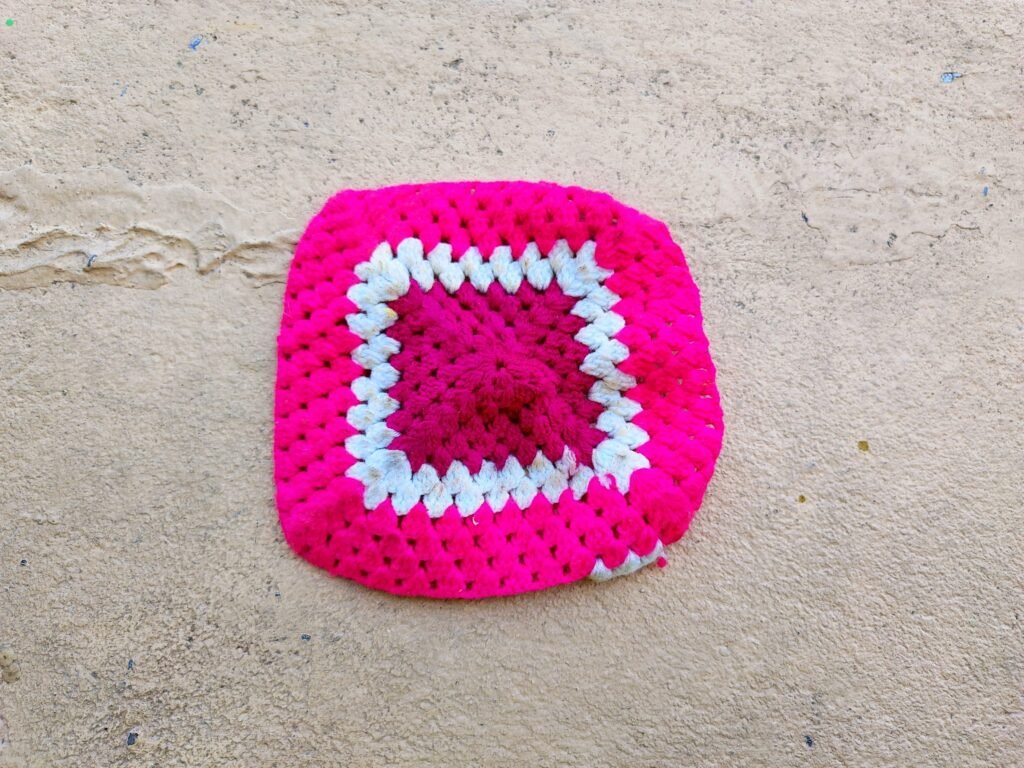
Our cosy granny stripe blanket is written in UK terms and uses the same three-treble clusters as a granny square, worked in rows. It is a lovely way to practise reading UK patterns with confidence.
UK vs US crochet terms in amigurumi and baby patterns
Amigurumi is one of the areas where UK vs US crochet terms matter most. Toy patterns are mostly worked in the shortest basic stitch, which is UK double crochet or US single crochet, and many amigurumi patterns online are written in US terms, so expect to see ‘sc’ throughout.
Most amigurumi also starts with a magic ring. The ring itself is the same in both systems, and our guide to how to do a crochet magic ring walks you through it.
Baby items often use half trebles for softness and drape. Our easy crochet baby booties pattern uses UK half trebles, which are US half double crochet. If you are used to US patterns, keep that one conversion in mind and the rest of the pattern will feel familiar.
Common mistakes with UK vs US crochet terms
- Guessing the terms from the website. A UK website can share a pattern in US terms. Always check the abbreviations list.
- Converting halfway through. Decide on one system before you start and stick with it for the whole pattern.
- Mixing up the decreases. dc2tog in a UK pattern and dc2tog in a US pattern are different stitches.
- Ignoring tension. Even with the right stitches, a different hook or yarn will change the size.
- Trusting old hook numbers. Where you can, check the millimetre size printed on the hook.
If your work looks wrong after a few rows, stop and compare it with the photo. It is much easier to pull back three rows than thirty.
Making UK vs US crochet terms second nature
You do not need to memorise everything at once. Most patterns only use three or four basic stitches, so you only ever need a handful of conversions at a time.
Try these habits:
- Keep the conversion chart saved on your phone or printed next to your yarn basket.
- Say the stitch name out loud in both systems as you work, for example ‘UK treble, US double’.
- Choose one system as your home language and translate everything into it.
- Label your own notes clearly with ‘UK terms’ or ‘US terms’ at the top.
After a few projects, switching between UK vs US crochet terms becomes almost automatic. You will glance at a pattern, spot the ‘sc’ or the ‘tension square’, and know straight away which system you are reading.
Frequently asked questions about UK vs US crochet terms
Why are UK and US crochet terms different?
UK terms name a stitch by the number of loops on the hook once the first loop has been pulled up. US terms name it by how many times you yarn over and pull through two loops to finish it. Because they count different things, the same word describes different stitch heights.
What is UK double crochet in US terms?
UK double crochet (dc) is exactly the same stitch as US single crochet (sc). It makes a firm, dense fabric that is ideal for amigurumi, bags and washcloths.
What is UK treble crochet in US terms?
UK treble crochet (tr) is the same stitch as US double crochet (dc). It is the stitch used in traditional granny squares and many blankets.
How can I tell if a pattern uses UK or US terms?
Look for single crochet (sc). If it appears anywhere, the pattern uses US terms, because UK terminology has no single crochet. Spelling helps too: colour and tension square suggest a British pattern, while color and gauge suggest an American one.
Do stitch counts change when converting UK vs US crochet terms?
No. When you switch between UK vs US crochet terms, only the stitch names change. The number of stitches, rows and repeats stays exactly the same, so the finished piece will match the pattern as long as you use the right stitches and tension.