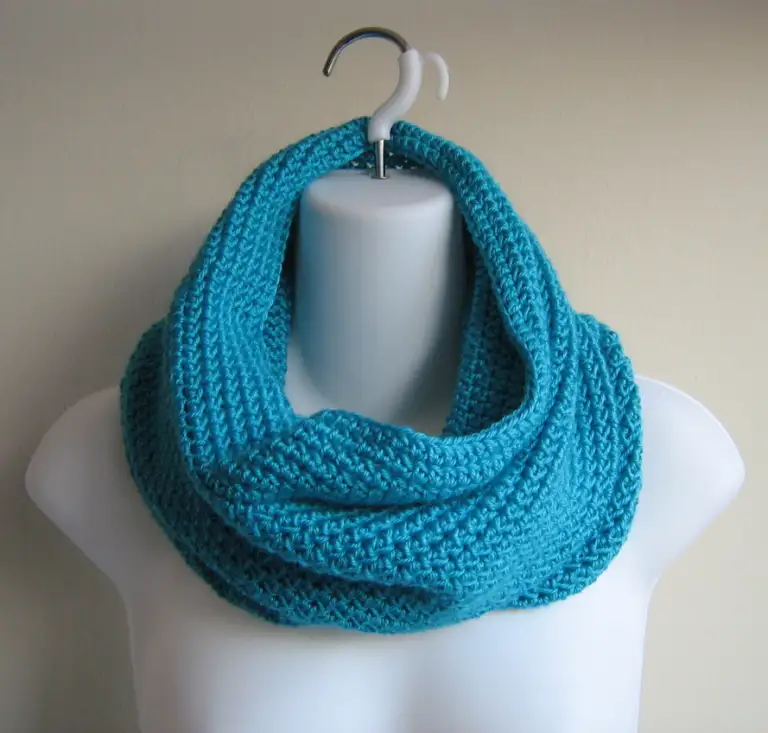
A crochet cowl is one of the quickest and most useful winter makes. It keeps your neck warm without the loose ends of a scarf, it never slips off, and it looks good with everything from a school coat to a smart wool jacket. Because it is a short loop, a cowl also uses far less yarn than a full-length scarf.
This page has three free crochet cowl patterns in UK terms with US conversions: a chunky ribbed cowl worked in rounds, a long moss stitch infinity scarf that wraps twice, and a button cowl worked flat in rows. All three are beginner friendly, with exact stitch counts, a diagram and tips for choosing the right yarn.
Quick answer: To crochet a cowl, chain about 60 in chunky yarn, join the chain into a ring without twisting it, and work rounds of half treble crochet until the cowl is about 25cm deep. For a longer infinity scarf, chain 210 in aran yarn and work rounds of moss stitch. For a button cowl, crochet a 65 x 20cm rectangle and fasten the overlapping ends with two buttons.
Why make a crochet cowl?
- Quick. The chunky cowl takes about 3 hours, so you can make one in an evening.
- Uses little yarn. One or two balls of chunky yarn are enough for most cowls.
- No shaping. Cowls are straight tubes or rectangles, with no increases or decreases.
- Great gifts. A cowl fits almost everyone, so you do not need to know anyone's size.
If you prefer a traditional long scarf, see our crochet scarf pattern instead.
What you need
| Item | What to use |
|---|---|
| Yarn | Chunky (bulky) for the ribbed cowl and button cowl, aran (worsted) for the infinity scarf. Amounts are given with each pattern. |
| Hooks | 8mm (UK 0, US L-11) for the chunky cowls, 6mm (UK 4, US J-10) for the infinity scarf |
| Extras | Stitch marker, tapestry needle, scissors, two large buttons (about 3cm) for the button cowl |
Not sure which hook to buy? Our crochet hook size guide has a full UK and US conversion chart.
The best yarn for a crochet cowl
A cowl sits right next to your skin, so softness matters more than for almost any other project. Merino wool, alpaca blends and soft acrylics all work well. Wool is the warmest and keeps you cosy even when it is damp, while acrylic is cheaper and machine washable. Avoid scratchy, hairy yarns if you have sensitive skin.
Chunky is weight 5 (bulky) and aran is weight 4 (medium) in the Craft Yarn Council yarn weight system. Our crochet yarn guide explains all the other weights.
Abbreviations (UK terms)
| UK term | US term | Meaning |
|---|---|---|
| ch | ch | chain |
| sl st | sl st | slip stitch |
| dc | sc | double crochet (US single crochet) |
| htr | hdc | half treble crochet (US half double crochet) |
| sk | sk | skip |
| sp | sp | space |
| st(s) | st(s) | stitch(es) |
New to the main stitch? Our half treble crochet guide shows it step by step, and our UK vs US crochet terms chart helps if you usually follow US patterns.
The three crochet cowls at a glance
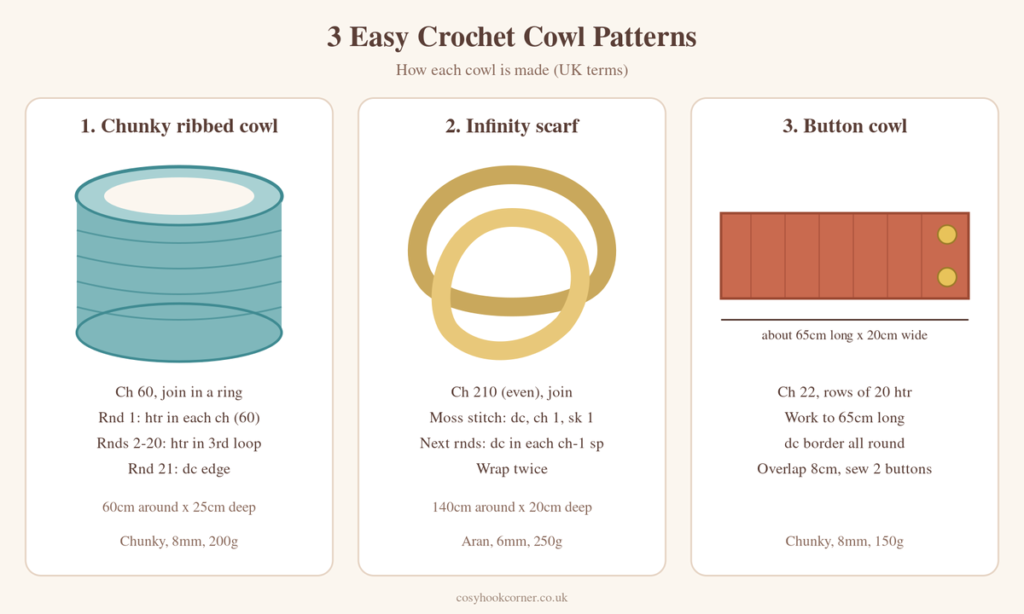
The diagram shows how each cowl is made, with its stitch counts and finished size.
| Cowl | Finished size | Yarn | Hook | Time |
|---|---|---|---|---|
| Chunky ribbed cowl | about 60cm around, 25cm deep | about 200g chunky | 8mm | about 3 hours |
| Moss stitch infinity scarf | about 140cm around, 20cm deep | about 250g aran | 6mm | about 6 hours |
| Button cowl | about 65 x 20cm before buttoning | about 150g chunky | 8mm | about 3 hours |
Pattern 1: chunky ribbed crochet cowl
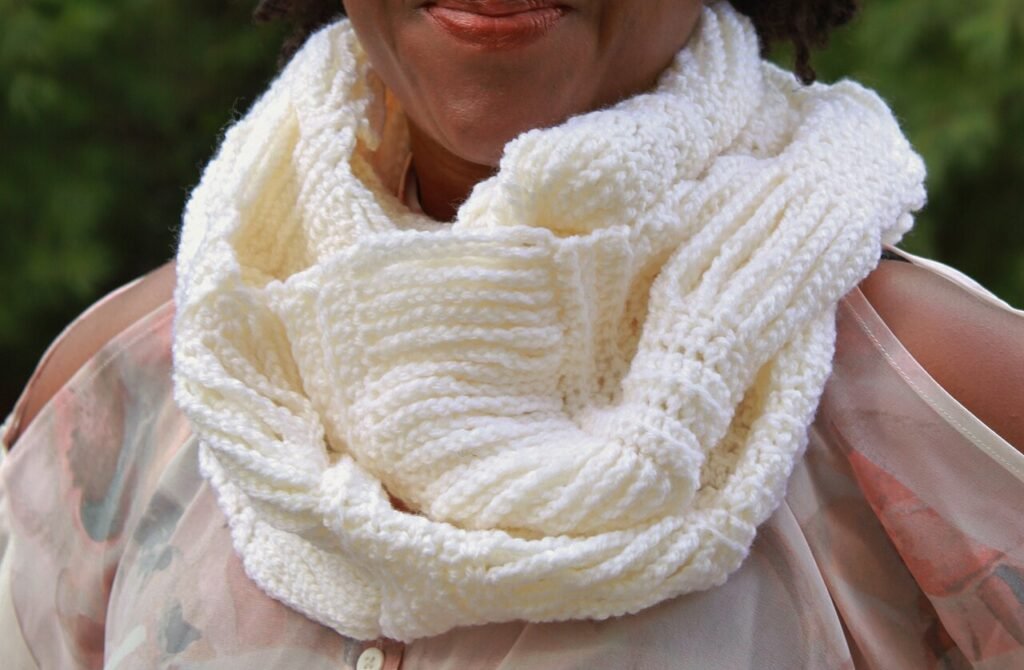
This simple crochet cowl pattern is worked in joined rounds of half treble crochet. Working into the third loop of each stitch makes horizontal ridges that look like knitted ribbing.
Yarn and hook: about 200g chunky yarn and an 8mm hook. Tension: 10 htr and 8 rounds = 10cm.
Foundation: ch 60. Check that the chain is not twisted, then sl st into the first ch to make a ring.
Rnd 1: ch 2 (does not count as a st), 1 htr in each ch around, sl st to the first htr. (60)
Rnd 2: ch 2, 1 htr in the third loop of each st around, sl st to the first htr. (60) The third loop is the horizontal bar just below the top two loops, on the back of a half treble.
Rnds 3 to 20: repeat rnd 2. The cowl should measure about 25cm deep.
Rnd 21: ch 1, 1 dc in each st around, sl st to the first dc. Fasten off and weave in the ends.
For a looser cowl that pulls up over your head like a hood, start with ch 70 and work 26 rounds.
Pattern 2: moss stitch infinity scarf
This long crochet infinity scarf is worked in rounds of moss stitch (also called linen stitch). It is long enough to wrap twice around your neck, and the woven texture looks smart and lies flat.
Yarn and hook: about 250g aran yarn and a 6mm hook. Tension: 15 sts and 18 rounds = 10cm in moss stitch (count each dc and each ch-1 sp as one stitch).
Foundation: ch 210. Check the chain is not twisted, then sl st into the first ch to make a ring. The number of chains must be even.
Rnd 1: ch 1, 1 dc in the first ch, *ch 1, sk 1 ch, 1 dc in the next ch; rep from * until 1 ch remains, ch 1, sk the last ch, sl st to the first dc. (105 dc and 105 ch-1 sps)
Rnd 2: sl st into the next ch-1 sp, ch 1, 1 dc in the same sp, *ch 1, 1 dc in the next ch-1 sp; rep from * around, ch 1, sl st to the first dc.
Repeat rnd 2 until the infinity scarf measures about 20cm deep. Fasten off and weave in the ends.
For stripes, change colour every 4 rounds. Moss stitch is also lovely for blankets; see our moss stitch crochet blanket to try it at a bigger size.
Pattern 3: crochet button cowl
This cowl is a simple rectangle worked flat in rows. You wrap it around your neck, overlap the ends and fasten it with two big buttons, so it is easy to take on and off without messing up your hair.
Yarn and hook: about 150g chunky yarn, an 8mm hook and two 3cm buttons. Tension: 10 htr and 8 rows = 10cm.
Foundation: ch 22.
Row 1: 1 htr in the 3rd ch from hook and in each ch to the end, turn. (20)
Row 2: ch 2 (does not count as a st), 1 htr in each st to the end, turn. (20)
Repeat row 2 until the cowl measures about 65cm long, or long enough to go around your neck with an 8cm overlap. Work 1 round of dc evenly around all four edges, working 3 dc into each corner, then fasten off.
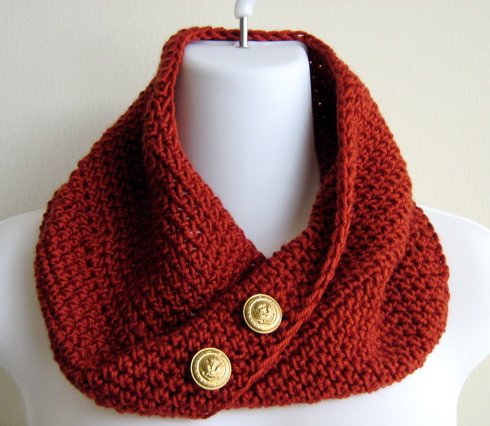
Buttons: wrap the cowl around your neck and overlap the ends by about 8cm. Mark where the buttons should go, then sew both buttons through both layers, one about 5cm from the top and one about 5cm from the bottom. Because the stitches are big, you do not need buttonholes: the cowl stays fastened by the buttons alone.
How to choose the right size for your crochet cowl
Cowls come in three main lengths, and the right one depends on how you like to wear it:
| Style | Circumference | How it sits |
|---|---|---|
| Neck warmer | 50 to 60cm | Snug around the neck, perfect under a coat |
| Loose cowl or hood cowl | 70 to 90cm | Drapes softly and can be pulled up over the head |
| Infinity scarf | 130 to 160cm | Wraps twice for a full, cosy look |
To change the size of any crochet cowl in this post, measure your tension swatch and multiply the stitches per centimetre by the circumference you want. For the chunky cowl, any number of chains works. For the moss stitch infinity scarf, round the number to an even figure. A good rule is that a cowl you want to pull over your head should be at least 56cm around, which is about the size of an adult head.
For children, make the chunky cowl with ch 50 and work 16 rounds. It is a quick and safe alternative to a long scarf, because there are no loose ends to catch on playground equipment.
How to wear a crochet cowl
- Close fit: wear the chunky cowl as it is, sitting snugly around your neck under a coat collar.
- Double wrap: loop the infinity scarf over your head, twist it once and loop it over again for a cosy double layer.
- Hood: pull a loose cowl up over your head on windy days.
- Off-centre buttons: wear the button cowl with the buttons at the side for a smart look.
Ideas for your crochet cowl
- Matching set: make a crochet hat, crochet mittens or a crochet ear warmer in the same yarn.
- Two-tone ribbing: change colour every 4 rounds on the chunky cowl for bold stripes.
- Fringe: add a short fringe to the bottom edge of the button cowl.
- Gift set: wrap a cowl with a pair of our crochet slippers for a cosy winter present.
For more quick presents, see our easy crochet gifts list.
Common problems and how to fix them
The crochet cowl is twisted
The foundation chain was twisted when you joined it. Unfortunately this cannot be fixed later, so lay the chain flat and check carefully before you work the first slip stitch. You can also work the first row flat and join it at the end of row 1, which makes it easier to see the chain.
The cowl is too tight to pull over my head
Your tension is tighter than 10 htr to 10cm. Go up to a 9mm hook, or add 6 more chains to the foundation.
The edges flare out
Work the final dc round with a hook one size smaller to pull the edge in slightly.
The join leaves a visible seam
The slip stitch join at the end of each round makes a faint line. Move the start of each round along by one stitch, or wear the seam at the back of your neck.
Caring for your crochet cowl
Hand wash wool cowls in cool water with a gentle wool wash, squeeze out the water in a towel and dry flat. Acrylic cowls can usually go in the washing machine on a cool, gentle cycle. Never hang a wet cowl, as the weight of the water stretches it.
For even more warmth, our crochet balaclava combines a hat, hood and cowl in one piece.
Frequently asked questions about crochet cowls
What is the difference between a cowl and an infinity scarf?
A cowl is a short loop that sits close around your neck. An infinity scarf is a longer loop, usually 130 to 160cm around, that you wrap twice.
How much yarn do I need for a crochet cowl?
About 150 to 200g of chunky yarn for a short cowl and about 250g of aran yarn for a long infinity scarf.
How long does it take to crochet a cowl?
About 3 hours for a chunky cowl and about 6 hours for a long infinity scarf.
Is a crochet cowl good for beginners?
Yes. Cowls have no shaping, so they are one of the best first wearable projects after a scarf or a dishcloth.
Can I make these crochet cowl patterns in US terms?
Yes. Use US single crochet for dc and US half double crochet for htr. The stitch counts stay the same.