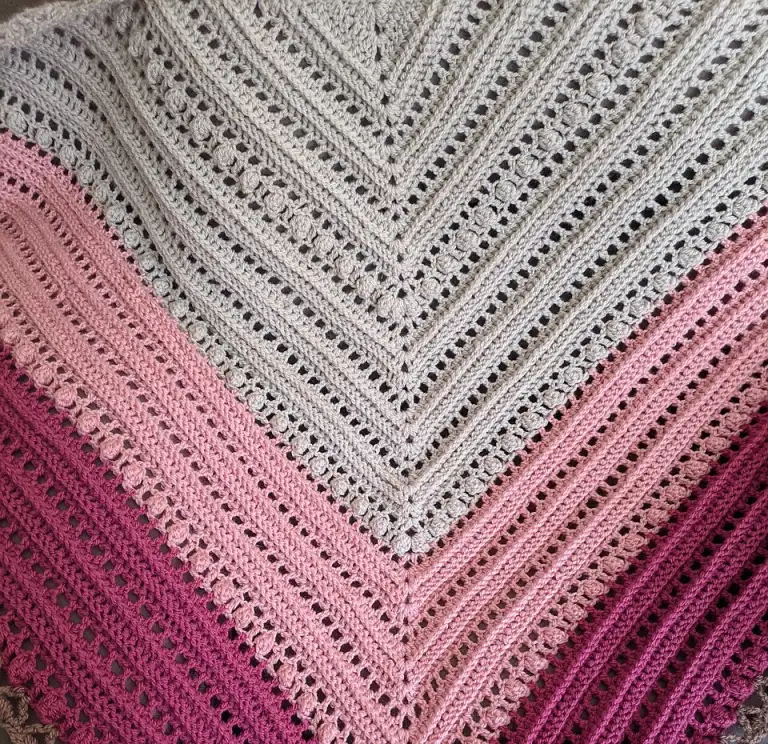
A moss stitch crochet blanket is one of the most satisfying makes you can put on your hook: it uses just one simple stitch and a chain, yet the finished fabric looks woven, neat and wonderfully squishy. The stitch is also called linen stitch or granite stitch, and once you have done two rows you will have the rhythm for the whole moss stitch crochet blanket.
At a glance: Yarn and hook: DK yarn and a 4mm (UK 8) hook (US G-6). Time: 25 to 40 hours for the lap size. Terms: UK, with US conversions.
This free pattern is written in UK and US terms. We use UK terms first, so double crochet (dc; US single crochet, sc) is the main stitch, with the US name given alongside. If you usually follow American patterns, our guide to UK vs US crochet terms explains the difference in more detail.
Below you will find the exact starting rows, the stitch-count logic, a sizes table from baby to single bed, stripe ideas, a simple border and care tips.
Why choose a moss stitch crochet blanket?
Moss stitch is a favourite with beginners and experienced makers alike. It is worked in short double crochet (dc; US single crochet, sc) stitches separated by single chains, so the fabric is dense enough to be warm but still drapes nicely.
- Only two things to remember: one dc, one chain, repeated across every row.
- No holes: each dc fills the chain space below, so the fabric is closed and cosy.
- Looks good on both sides: the right and wrong sides look very similar.
- Brilliant for stripes: colours blend into a tweedy, woven look where they meet.
- Easy to resize: any even number of chains works, so a moss stitch crochet blanket can be any width.
If you would like to compare it with other first blankets, have a look at our round-up of easy crochet blanket patterns, or try the bolder geometric look of a corner to corner crochet blanket.
UK and US crochet terms used in this pattern
All instructions use UK terms. Here is a quick table so readers in the US, Canada, Australia and New Zealand can follow along with confidence.
| Abbreviation (UK) | UK term | US term |
|---|---|---|
| ch | chain | chain (ch) |
| dc | double crochet | single crochet (sc) |
| ss | slip stitch | slip stitch (sl st) |
| ch-sp | chain space | chain space (ch-sp) |
| sp | space | space (sp) |
| rep | repeat | repeat (rep) |
You will only need a slip stitch (ss; US slip stitch, sl st) for joining the border. If it is new to you, our slip stitch crochet guide walks through it step by step.
Materials for a moss stitch crochet blanket
You do not need anything special. A smooth yarn in a light colour shows the woven texture best, especially for your first moss stitch crochet blanket.
- Yarn: double knitting (DK) weight, in a soft acrylic, cotton or wool blend. See the sizes table below for rough amounts.
- Hook: 4mm (UK 8, US G-6), plus a 4.5mm or 5mm hook for the foundation chain if your chains tend to be tight.
- Stitch markers: two or three, to mark the turning chain while you learn.
- Tapestry needle for weaving in ends, and a pair of scissors.
Not sure which yarn to pick? Our guide to crochet yarn explains fibres and weights, and the Craft Yarn Council yarn weight system is a handy reference for matching DK (often called light worsted or weight 3) between UK and US labels. For hooks, see our crochet hooks guide.
How moss stitch works
Every row is made of the same two parts: a double crochet (dc; US single crochet, sc) and a chain. You work 1 ch, skip the next stitch, then make the next dc into a chain space. On every row after the first, each dc goes into the ch-1 space of the row below, and each ch sits on top of a dc below.
Because each new stitch is offset from the one beneath it, the stitches stagger like bricks. That staggering is what gives a moss stitch crochet blanket its woven, almost tweed-like texture.

Why the starting chain must be an even number
The stitch repeat is two chains wide: one ch that you skip and one ch that you work a dc into. The first three chains at the start of row 1 also work as a pair plus the turning chain. Together, that means the pattern only comes out evenly over an even number of foundation chains.
If you start with an odd number, you will end row 1 with a chain left over, and the edges will never line up. So before you start, count your foundation chain and add one if needed.
How to crochet the moss stitch crochet blanket
Here is the full pattern in UK terms, with US terms in brackets. Practise it first on a small swatch of 20 ch before you start.
Foundation chain
Make an EVEN number of chains. For a practice swatch, ch 20. For your moss stitch crochet blanket, use the starting chain from the sizes table below. Use a hook one size larger for the chain if yours tend to pull tight.
Row 1
Row 1: 1 dc (US sc) in the 4th ch from the hook, *ch 1, skip the next ch, 1 dc (US sc) in the next ch; rep from * to the end, working the last dc into the last ch. Turn.
The three chains you skipped at the start form a small loop. On the next row you will work into that loop as if it were a chain space, so do not ignore it.
Row 2
Row 2: Ch 2 (this counts as the first dc and a ch-1 space), skip the first dc, 1 dc (US sc) in the first ch-1 space, *ch 1, skip the next dc, 1 dc (US sc) in the next ch-1 space; rep from * to the end, working the last dc into the turning-chain loop (the space under the 3 skipped chains from row 1). Turn.
Row 3 and every row after
Row 3 onwards: Ch 2 (counts as first dc and a ch-1 space), skip the first dc, 1 dc (US sc) in the first ch-1 space, *ch 1, skip the next dc, 1 dc (US sc) in the next ch-1 space; rep from * to the end, working the last dc into the space under the ch-2 at the end of the row. Turn.
Repeat row 3 until the moss stitch crochet blanket is the length you want, then fasten off or go straight into the border.
How to turn neatly
- At the end of each row, turn the work towards you, like turning a page.
- Make the ch 2 straight away. Do not work into the dc right at the base of the ch 2: that dc is skipped, and the first new dc goes into the first ch-1 space.
- At the far end, the last dc always goes into the space under the turning chain. Many makers place a stitch marker in each ch 2 for the first few rows so it is easy to find.
Stitch-count logic
Every row has exactly the same count. If your foundation chain is N (an even number), each row has:
- (N minus 2) divided by 2 double crochet stitches (dc; US single crochet, sc), not counting the turning chain;
- one fewer ch-1 space than that between them;
- plus the turning chain at the start (from row 2 on, a ch 2).
For the 20-chain swatch that gives 9 dc and 8 ch-1 spaces in every row. On row 2 you have 8 ch-1 spaces plus the turning-chain loop to work into, which makes 9 places for 9 new dc, so the count never changes.
A quick check: count the dc across a row every 10 rows or so. If the number has gone up or down, look at the edges first, as that is where almost all mistakes happen.
Gauge and moss stitch crochet blanket sizes
Gauge (tension) matters if you want your moss stitch crochet blanket to come out at a particular size. Our sample gauge, used for the table below, is:
Sample gauge: 20 stitches and 22 rows = 10cm (4in) in moss stitch with DK yarn and a 4mm hook, counting each dc (US sc) and each ch-1 as one stitch.
Your own gauge may differ, so make a swatch of about 15cm square, measure the middle 10cm, and adjust. If you have more stitches than ours, go up a hook size; if you have fewer, go down. You can also simply measure your swatch and work out your own starting chain: multiply your stitches per cm by the width you want, round to an even number and add 2.
| Size | Approx. finished size (before border) | Starting chain (even) | Approx. rows | Rough DK yarn amount |
|---|---|---|---|---|
| Baby | 75 x 90cm (29.5 x 35.5in) | 152 ch | about 198 | 800 to 1,000m |
| Lap | 100 x 130cm (39.5 x 51in) | 202 ch | about 286 | 1,600 to 1,900m |
| Single bed | 140 x 200cm (55 x 79in) | 282 ch | about 440 | 3,400 to 4,000m |
Yarn amounts for each moss stitch crochet blanket size are rough guides only, as the fabric is quite dense and tension varies a lot between makers. Check the metres per ball on your yarn band, and buy at least one extra ball from the same dye lot, plus extra for a border.
Making for a new arrival? Our crochet newborn blanket guide covers smaller pram and cot sizes and baby-safe yarn choices.
Stripe and colour ideas for a moss stitch crochet blanket
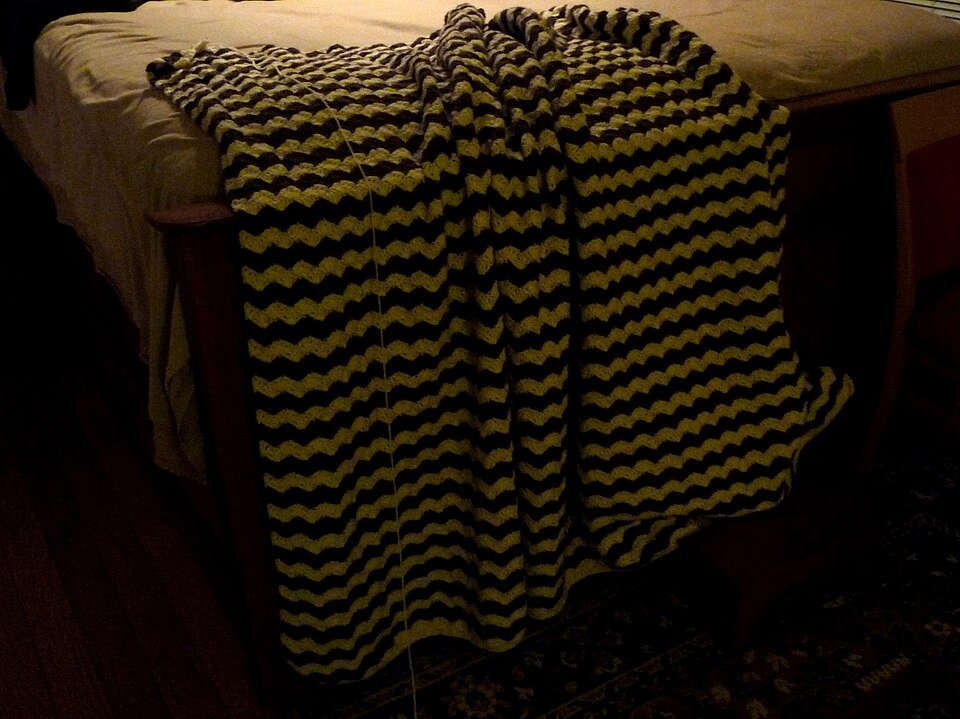
Moss stitch looks great in stripes. Because each row dips into the row below, the colours interlock slightly, giving a soft, flecked line rather than a hard edge.
- Two-row stripes: change colour every 2 rows. The yarn changes always happen on the same side, and you can carry the unused colour up the edge.
- Classic three-colour repeat: for example cream, sage and rust, 4 rows of each.
- Single-row pin stripes: 1 row of a contrast colour between wider bands of the main colour. This gives a lovely tweedy look.
- Ombre or gradient: a moss stitch crochet blanket in five or six shades from light to dark, changing every 10 to 20 rows.
- Scrappy stripes: a scrappy moss stitch crochet blanket uses up leftover DK in random widths. Keep one neutral between brights.
- Seasonal palettes: autumn browns and mustard, or Christmas red, green and cream.
How to change colour neatly
Work the last double crochet (dc; US single crochet, sc) of the row until two loops remain on the hook. Drop the old colour, pick up the new one and pull it through both loops to finish the stitch. Turn, ch 2 in the new colour and carry on.
For 2-row stripes, leave the old colour attached and carry it loosely up the side. For wider stripes, cut the yarn leaving a 15cm tail to weave in later.

If you enjoy playing with colour, our crochet star blanket is another great project for using several shades in one design.
Keeping the edges of your moss stitch crochet blanket straight
Wavy or slanting edges are the most common problem with a moss stitch crochet blanket, and they almost always come from the first or last stitch of a row.
- Do not work into the first dc. After the ch 2, skip the dc at the base and go into the first ch-1 space.
- Always use the turning-chain space. The last dc of every row goes into the space under the turning chain. Missing it makes the blanket narrower; working twice there makes it wider.
- Mark the turning chain. A stitch marker in the ch 2 for the first 10 rows helps you learn where the last stitch goes.
- Count often. Check your dc count every 10 rows against the stitch-count logic above.
- Keep the foundation chain loose. A tight chain pulls the bottom edge of a moss stitch crochet blanket in. A bigger hook for the chain solves this.
- Block at the end. Lay the finished piece flat, gently ease the edges straight and let it dry.
A simple border for a moss stitch crochet blanket
A border neatens the sides and frames the texture. This simple version uses only double crochet (dc; US single crochet, sc) and a slip stitch (ss; US slip stitch, sl st). For more styles, see our full guide to crochet blanket borders.
Round 1: With the right side facing, join yarn in a corner. Work dc (US sc) evenly around all four sides: along the top and bottom edges, 1 dc in each dc and 1 dc in each ch-1 space; along the side edges, about 1 dc in the end of each row. Work 3 dc in each corner. Join with a ss (US sl st) to the first dc.
Rounds 2 and 3: Ch 1 (does not count as a stitch), 1 dc in each dc around, working 3 dc in the centre dc of each corner. Join with a ss to the first dc. Fasten off.
If the sides ripple, you have too many stitches along them: take out the round and skip a row end every so often. If the sides pull in, add an extra dc every few row ends. A border in a contrast colour from your stripes makes a moss stitch crochet blanket look especially smart.

Washing and caring for your blanket
Always follow the care instructions on your yarn band, as fibres differ. These general tips keep a moss stitch crochet blanket looking good for years.
- Keep a ball band. Pop one in a drawer so you always know the care instructions.
- Machine-washable yarns: use a gentle or wool cycle at a low temperature, ideally inside a large laundry bag.
- Wool and wool blends: hand wash in cool water with a wool wash, and do not wring or rub.
- Drying: press out water by rolling the blanket in a towel, then dry it flat and reshape it. Hanging a heavy, wet blanket can stretch it.
- Tumble drying: only if the yarn band says it is suitable, and on a low heat.
- Storage: fold and store it somewhere dry. Avoid hanging it over a rail for long periods.
A note for baby blankets
A moss stitch crochet blanket is a good choice for babies because it has no large holes for little fingers. Weave all ends in securely and avoid adding buttons, beads or long ties. For very young babies, follow safe-sleep advice from the NHS baby pages: place your baby feet to foot, keep any blanket tucked in no higher than the shoulders, and avoid loose bedding.
The moss stitch also makes a beautiful wrap: see the moss stitch version in our crochet shawl patterns.
The moss stitch also makes a lovely textured crochet cardigan.
Frequently asked questions about moss stitch crochet blankets
Is moss stitch the same as linen stitch and granite stitch?
Yes. Moss stitch, linen stitch and granite stitch are names for the same crochet pattern: double crochet (US single crochet) and a chain, with each dc worked into the chain space of the row below. Knitted moss stitch is a different stitch altogether.
How many chains do I need to start a moss stitch crochet blanket?
Any even number. As a guide, with our sample gauge of 20 stitches to 10cm in DK, start with 152 ch for a baby blanket, 202 ch for a lap blanket and 282 ch for a single bed. Always check your own gauge first.
Is moss stitch good for beginners?
Yes. If you can make a chain and a double crochet (US single crochet), you can make it. The only tricky part is the edges, so count your stitches regularly for the first few rows.
Does moss stitch use a lot of yarn?
A moss stitch crochet blanket is a fairly dense fabric, so it uses more yarn than open stitches such as granny stripes. As a rough guide, allow 1,600 to 1,900m of DK for a lap blanket and buy an extra ball in the same dye lot.
Can I use chunky yarn instead of DK?
Yes. Use the hook size on the ball band, make a swatch, measure your stitches per 10cm and work out a new even starting chain. A chunky moss stitch crochet blanket grows faster but will be heavier.
Ready to start?
Make a 20-chain swatch tonight, get comfortable with the turn and the last stitch, and you will be ready to start your first moss stitch crochet blanket. Once you have mastered it, try the colourful granny stripe blanket for a different kind of easy, relaxing blanket project.