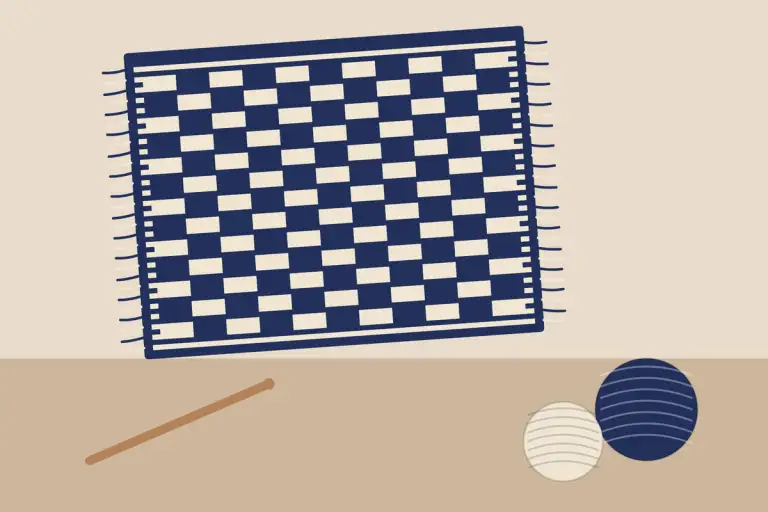
A mosaic crochet blanket looks complicated, but it is one of the most relaxing big projects you can make. You only ever use one colour at a time, there are just two stitches, and the bold geometric pattern appears row by row as you work. If you have ever wanted a modern, graphic blanket without fiddly colour changes in the middle of a row, mosaic crochet is the answer.
This free mosaic crochet blanket pattern is written in UK terms with US conversions. It uses overlay mosaic crochet to make a staggered “bricks” design in two colours, with a chart, a written pattern for every row, a 22-stitch practice swatch, and stitch counts for a baby blanket and a large throw. You will also find ideas for using up the many yarn ends as a fringe, plus a simple border.
Quick answer: To make a mosaic crochet blanket, chain a multiple of 8 plus 7 in DK yarn, work 3 set-up rows, then repeat an 8-row pattern of back-loop double crochet and long trebles dropped into the front loop two rows below. Work every row with the right side facing, change colour every row, and finish with a fringe or a simple double crochet border.
Why this mosaic crochet blanket pattern is easy
- Only two stitches. Double crochet in the back loop, and a treble dropped down to the row two below. Nothing else.
- One colour per row. No carrying yarn, no bobbins and no tangles.
- An 8-row repeat. Once you have worked Rows 4 to 11 a couple of times, you will hardly need the chart.
- Easy to resize. The pattern works over any multiple of 8 stitches plus 6, so you can make a baby blanket, a lap blanket or a big throw.
- The ends become a feature. Each row leaves two tails, and you can knot them into a fringe along the sides instead of weaving them in.
If mosaic crochet is completely new to you, read our mosaic crochet pattern for beginners first. It explains overlay and inset mosaic and has a small practice square, so you will already know both stitches before you start this blanket.
What you need for a mosaic crochet blanket
- Yarn: DK weight in two strongly contrasting colours. This pattern calls them colour A (cream) and colour B (navy). Smooth acrylic, cotton or an acrylic and wool blend all work well.
- Amount: approximately 450g of each colour for the baby blanket and approximately 1.35kg of each colour for the throw. See “How much yarn do I need” below to check this against your own tension.
- Hook: 4mm (UK 8, US G-6). Use 4.5mm if your fabric feels stiff.
- Extras: scissors, a tapestry needle, a few stitch markers and a piece of card about 12cm wide if you want to make a fringe.
DK is weight 3 (light) in the Craft Yarn Council yarn weight system. Our crochet yarn guide explains yarn weights and fibres, and our crochet hook size guide has a UK, US and metric conversion chart.
Choosing colours for a mosaic blanket
The pattern only shows up if the two colours are very different in value (how light or dark they are). Navy and cream, black and white, charcoal and mustard, or forest green and oatmeal all look striking. Two mid-tones such as red and green can look muddy, even if they are bright. A quick test: take a photo of the two balls of yarn and turn it black and white. If you can still tell them apart easily, they will work.
Best yarn for a mosaic crochet blanket
Any smooth DK yarn will make a good mosaic crochet blanket, but each fibre gives a slightly different result:
| Yarn | Good for | Things to know |
|---|---|---|
| 100% acrylic | Baby blankets and everyday throws | Soft, machine washable and easy to find in lots of colours. Choose an anti-pill acrylic for a blanket that will be used a lot. |
| Cotton or cotton blend | Summer blankets and crisp patterns | Shows the mosaic lines very sharply, but it is heavier, so a throw will need more yarn and feel weightier. |
| Wool and acrylic blend | Warm winter throws | Warm, light and springy. Check the ball band to see if it can go in the washing machine. |
For a first mosaic crochet blanket, a soft acrylic DK in two very different shades is the easiest choice. It is forgiving, it does not split, and it blocks well. Avoid fluffy, chunky or variegated yarns, because they hide the long trebles and blur the bricks. If you are making a mosaic crochet blanket for a baby, choose a yarn that is soft, washable and labelled as suitable for babies, and keep the fringe short or use the border option instead.
Abbreviations (UK terms with US equivalents)
- ch chain
- dc double crochet (US single crochet)
- dc BLO double crochet into the back loop only
- edge dc double crochet into both loops (always the first and last stitch of a row)
- tr FL2B treble (US double crochet) into the front loop of the stitch two rows below, keeping it in front of the row in between. Skip the stitch behind it in the current row.
- A / B colour A / colour B
If you usually follow US patterns, keep our UK vs US crochet terms chart open while you work, and see our treble crochet guide if you need a reminder of the treble stitch.
Tension and sizes
Tension: about 18 stitches and 22 rows to 10cm over the pattern with a 4mm hook. Tension matters less for a blanket than for a hat, but it changes how much yarn you need and how big the blanket will be.
| Size | Foundation chain | Stitches per row | Pattern repeats (Rows 4 to 11) | Finished size (approx.) |
|---|---|---|---|---|
| Practice swatch | 23 ch | 22 | 2 | 12 x 9cm |
| Baby blanket | 127 ch | 126 | 21 | 70 x 80cm |
| Throw | 207 ch | 206 | 38 | 115 x 145cm |
For any other width, chain a multiple of 8 plus 7 (that gives a multiple of 8 plus 6 stitches). For any other length, keep repeating Rows 4 to 11.
Important: how overlay mosaic crochet is worked
This mosaic crochet blanket uses the one-direction overlay method. Every row is worked with the right side facing you, from right to left (left to right if you are left-handed). At the end of every row, fasten off and leave a 12cm tail. Join the next colour at the same edge you started the last row, leaving another 12cm tail.
It feels strange at first to cut the yarn after every row, but it means the pattern is always facing you, you never have to work a wrong side row, and you can see straight away if a treble is in the wrong place.
Free mosaic crochet blanket pattern: bricks
The instructions below are for the 22-stitch swatch. For the baby blanket or throw, start with the chain from the size table and work the bracketed repeats across the whole row; every row still ends the same way.
Set-up rows
Foundation (A): 23 (127, 207) ch.
Row 1 (A): 1 dc in the 2nd ch from the hook and in each ch to the end. Fasten off. (22 (126, 206) sts)
Row 2 (B): join B in the first stitch. Edge dc, dc BLO in each stitch to the last stitch, edge dc. Fasten off.
Row 3 (A): work as Row 2 in colour A.
Pattern rows
Row 4 (B): edge dc, [dc BLO in each of the next 4 sts, tr FL2B in each of the next 4 sts] to the last 5 sts, dc BLO in each of the next 4 sts, edge dc.
Row 5 (A): edge dc, [tr FL2B in each of the next 4 sts, dc BLO in each of the next 4 sts] to the last 5 sts, tr FL2B in each of the next 4 sts, edge dc.
Row 6 (B): work as Row 4.
Row 7 (A): edge dc, dc BLO in each stitch to the last stitch, edge dc.
Row 8 (B): work as Row 5.
Row 9 (A): work as Row 4.
Row 10 (B): work as Row 5.
Row 11 (A): work as Row 7.
Fasten off at the end of every row. Repeat Rows 4 to 11 another 1 (20, 37) times, so you have 2 (21, 38) repeats in total.
Last row (B): work as Row 2. Fasten off.
Check the count at the end of every row: it should always be 22 (126, 206) stitches. The plain rows (7 and 11) are a natural rest point, and they are where the bricks change position, so the design steps across like a brick wall.
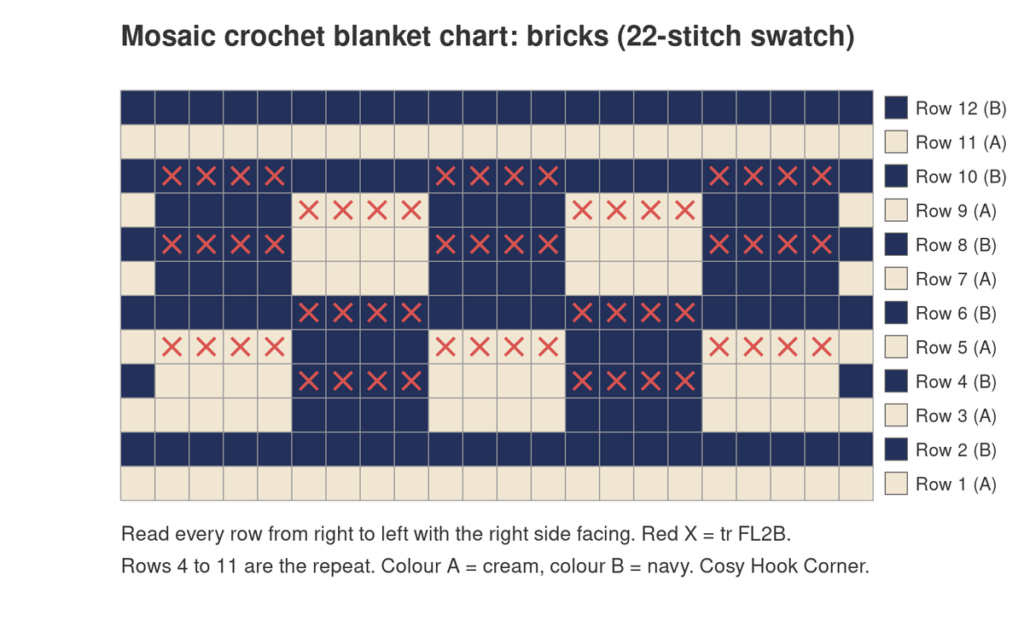
How to read the mosaic blanket chart
- Each square is one stitch and each row of squares is one row of crochet, read from right to left.
- The coloured box next to the row number shows which colour to use.
- A red X is a tr FL2B. Every other square is dc BLO (or edge dc at the ends).
- The squares show what you will see from the front: a treble covers the square below it in the colour of its own row.
Rows 1 to 3 and Row 12 are the set-up and finishing rows. Rows 4 to 11 are the repeat you will work again and again for the mosaic crochet blanket.
Tips for a neat mosaic crochet blanket
- Make the swatch first. Twenty minutes on the 22-stitch swatch will teach you the rhythm and show you whether you like your colours.
- Keep the long trebles relaxed. Pull up the first loop of each tr FL2B to the height of the current row. If it is too short, the fabric puckers; if it is too long, it looks loopy.
- Do not skip the edge dc. Working the first and last stitch through both loops gives straight, firm sides.
- Use markers on wide rows. On the throw, put a stitch marker every 5 repeats (40 sts) so you can count quickly.
- Tidy as you go. Knot or weave the ends every 20 rows, so you are not left with hundreds at the end.
- Block it. Spray the finished mosaic crochet blanket with water, pin it out flat and let it dry. Acrylic can be steam blocked lightly, holding the iron above the fabric.
What to do with the ends: fringe or border
A one-direction mosaic crochet blanket leaves two tails on every row, so the baby size has more than 300 ends. Here are two ways to deal with them:
Option 1: a fringe along the sides
This is the quickest finish and it suits the graphic look. Tie each pair of tails next to each other (one A row and one B row) together in an overhand knot close to the edge. When every pair is knotted, trim them all to the same length with the piece of card as a guide. Work a border of 4 rows of dc along the top and bottom edges only, in colour B.
Option 2: a simple border all round
If you prefer a clean edge, weave in the ends along the sides, then work a border in colour B:
- Round 1: dc evenly all around the blanket, working 1 dc in each stitch along the top and bottom and about 1 dc in each row end along the sides, with 3 dc in each corner. Join with a sl st.
- Rounds 2 to 4: ch 1, dc in each st around, with 3 dc in the centre stitch of each corner. Join with a sl st.
- Round 5: change to colour A and work one round of crab stitch (reverse dc) for a corded edge.
You can also crochet over the tails in Round 1 instead of weaving them in. Hold two or three tails along the edge and work the dc over them, then trim what is left. It is quick, but only do it with smooth yarn so the edge stays neat.
How much yarn do I need for a mosaic crochet blanket?
Mosaic crochet uses more yarn than plain double crochet, because the long trebles sit on top of the fabric and make it thicker. The amounts in “What you need” are estimates, so the best way to check is to weigh your swatch:
- Make the 22-stitch swatch and measure it, for example 12 x 9cm (108 square cm).
- Weigh it on kitchen scales, for example 17g.
- Work out the area of your blanket, for example 70 x 80cm = 5,600 square cm.
- Divide the blanket area by the swatch area and multiply by the swatch weight: 5,600 / 108 x 17g = about 880g.
- Add about 10% for the border and ends, then split it between the two colours.
Buy all your yarn from the same dye lot, because a change in shade in the middle of a mosaic crochet blanket is very easy to see.
More mosaic crochet blanket ideas
Once you know the bricks pattern, you can change the look of your blanket without learning anything new:
- Scrappy mosaic: keep colour B the same and change colour A every 16 rows to use up leftover DK yarn.
- Panels and stripes: work 24 rows of the pattern, then 8 rows of plain dc BLO, alternating colours. It makes the blanket faster and breaks the design into bands.
- Bigger bricks: make the blocks 6 stitches wide instead of 4 (a multiple of 12 plus 8 stitches) for a bolder pattern on a large throw.
- Matching cushion: make a 40cm square in the same pattern and sew it into a crochet cushion cover.
- Mosaic bag: mosaic fabric is thick and strong, so a long rectangle folded in half makes a sturdy tote. Add straps from our crochet bag patterns.
Looking for something simpler? Our easy crochet blanket patterns include solid, striped and granny designs, and our crochet baby blanket patterns are perfect for a first blanket.
Common problems with mosaic crochet blankets
The pattern does not line up
Count your stitches at the end of each row. One missed or extra stitch moves every treble that follows. Also check you skipped the stitch behind each tr FL2B.
The blanket is narrower at one end
This usually happens when the edge dc is skipped or worked into the back loop. Work the first and last stitch of every row through both loops.
The fabric curls or puckers
The long trebles are too tight. Pull the first loop up a little higher, or go up half a hook size. Blocking also helps a lot.
I can hardly see the pattern
Your colours are too close in value. Swap one of them for a much lighter or darker shade.