A crochet scarf pattern is one of the best first projects you can choose. A scarf is a simple rectangle, so you can focus on even stitches and neat edges without any shaping, and you end up with something you will actually wear all winter.
Quick answer: The easiest crochet scarf for beginners is a simple rectangle worked in rows. This guide has three free patterns in UK terms: a ribbed half treble scarf, a moss stitch scarf and a quick chunky treble scarf, using DK, aran or chunky yarn with a 5mm to 8mm hook and about 200g to 400g of yarn. Expect anything from a weekend to a couple of weeks.
Choose from three free crochet scarf patterns, all written in UK terms with exact chain counts and row repeats: a ribbed half treble scarf worked lengthwise in the back loops, a textured moss stitch scarf, and a quick chunky treble scarf. We also cover choosing yarn, adding a fringe or tassels, and blocking for a neat finish.
Every crochet scarf pattern here uses only basic stitches. If you can make a chain, a double crochet and a half treble, you can make all three.
Why a crochet scarf pattern is perfect for beginners
A scarf gives you lots of practice at one stitch, row after row. By the end of a single crochet scarf pattern your tension is usually far more even than when you started, and that skill carries into every project afterwards.
There is no shaping, no counting increases and no seaming. You only need to keep the same number of stitches in every row and stop when the scarf is long enough. If you make a mistake, it is easy to pull back a row or two and carry on.
Scarves are also forgiving on size. A scarf a few centimetres wider or longer than planned still works perfectly, which takes the pressure off while you are learning.

What you need for these crochet scarf patterns
You do not need much to get started. Each pattern lists its own yarn and hook, but the basic kit is the same for all three.
- Yarn: DK, aran or chunky weight, depending on the pattern you choose.
- Crochet hook: the size given in the pattern, plus one size larger for the foundation chain if your chains tend to be tight.
- Scissors for trimming ends and fringe.
- A blunt yarn needle for weaving in ends.
- Stitch markers to mark the first and last stitch of a row, which helps keep edges straight.
- A tape measure to check width and length as you go.
If you need help picking a hook, our guide to crochet hooks explains the UK and metric sizes.
UK and US terms used in this crochet scarf pattern guide
All three patterns use UK terms. If you usually follow US patterns, here is how the stitch names translate.
| Abbreviation | UK term | US term |
|---|---|---|
| ch | chain | chain |
| ss | slip stitch | slip stitch |
| dc | double crochet | single crochet (sc) |
| htr | half treble crochet | half double crochet (hdc) |
| tr | treble crochet | double crochet (dc) |
| blo | back loop only | back loop only |
| sp | space | space |
For a fuller list, see our UK vs US crochet terms chart.
Choosing yarn for a crochet scarf pattern
The yarn you choose changes how a scarf looks, feels and drapes. Soft yarn matters more for a scarf than for almost any other project, because it sits right against your neck and face.
Whichever crochet scarf pattern you pick, choose a yarn you enjoy touching. Before you buy, squeeze the ball and rub it against the inside of your wrist. If it feels scratchy there, it will feel scratchy around your neck too.
Yarn weight
Thicker yarn works up faster and makes a warmer, chunkier scarf. Thinner yarn takes longer but gives more drape and finer texture. The standard weight categories are explained on the Craft Yarn Council yarn weight system page.
| Yarn weight | Typical hook | Best for |
|---|---|---|
| DK | 4mm to 5mm | Lighter scarves with good drape and stitch detail |
| Aran | 5mm to 6mm | Everyday winter scarves |
| Chunky | 7mm to 9mm | Very quick, thick and cosy scarves |
Fibre
- Acrylic is soft, affordable, comes in lots of colours and is usually machine washable. It is a good choice for a first scarf.
- Wool and wool blends are very warm and block beautifully, but check the label for washing instructions.
- Cotton has little stretch and can feel heavy in a long scarf, so it suits lighter spring scarves best.
For a closer look at fibres and weights, read our guide to crochet yarn.
Colour
Pick a light or mid colour for your first scarf. It is much easier to see your stitches in cream, pale grey or a soft pastel than in black or navy.

Crochet scarf pattern 1: lengthwise ribbed half treble scarf
This free crochet scarf pattern is worked lengthwise, so each row runs the full length of the scarf. Working every row in the back loop only creates soft ridges that look a little like knitted ribbing. Because there are so few rows, it feels quick once the long foundation chain is done.
If you are new to the stitch, our step-by-step guide to half treble crochet shows how to work it.
Materials and size
- Yarn: aran weight, about 250g to 300g (roughly 500m to 600m). This is an estimate; it depends on your tension and the yarn.
- Hook: 5.5mm, plus a 6mm hook for the foundation chain if your chains are tight.
- Finished size: about 150cm long and 18cm wide, before fringe.
- Tension: not critical, but roughly 13 to 14 htr to 10cm.
Pattern
Foundation: Ch 202.
Row 1: Htr in 3rd ch from hook (the skipped 2 ch do not count as a stitch) and in each ch to the end. Turn. (200 htr)
Row 2: Ch 2 (does not count as a stitch), htr in the back loop only of each st to the end. Turn. (200 htr)
Repeat Row 2 until the scarf is about 18cm wide, roughly 18 to 20 rows in total. Fasten off and weave in the ends.
Tips for this pattern
- Place a stitch marker every 50 chains while you make the foundation chain. It makes counting to 202 much easier.
- Count your stitches at the end of Rows 1 and 2. If you have 200, the rest of the scarf will stay straight.
- To make it longer or shorter, add or remove chains in any number. You always have 2 fewer htr than chains.
Crochet scarf pattern 2: moss stitch scarf
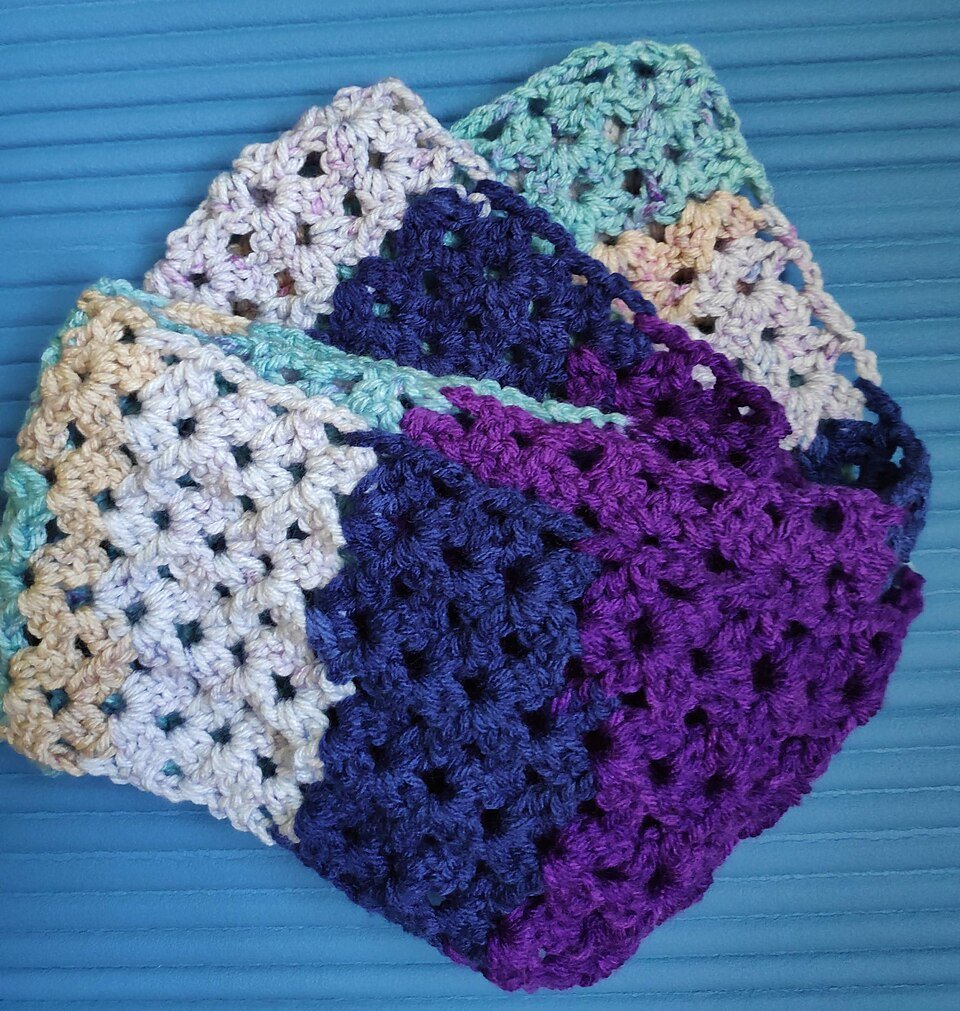
Moss stitch, sometimes called linen stitch, is made from double crochet stitches and single chains. The double crochet in each row sits in the chain spaces of the row below, giving a woven-looking texture that lies flat and does not curl. This crochet scarf pattern looks especially good in stripes.
Materials and size
- Yarn: DK weight, about 200g to 300g (roughly 450m to 650m). This is an estimate.
- Hook: 5mm. Moss stitch is quite dense, so going one size larger than usual for DK keeps it soft.
- Finished size: about 18cm wide and 160cm long.
- Tension: roughly 20 stitches (counting each dc and each ch) to 10cm.
Pattern
Foundation: Ch 38.
Row 1: Dc in 2nd ch from hook, *ch 1, skip next ch, dc in next ch; repeat from * to the end. Turn. (19 dc and 18 ch-1 sps)
Row 2: Ch 1 (does not count as a stitch), dc in first dc, dc in next ch-1 sp, *ch 1, skip next dc, dc in next ch-1 sp; repeat from * until 1 dc remains, dc in last dc. Turn. (20 dc and 17 ch-1 sps)
Row 3: Ch 1 (does not count as a stitch), dc in first dc, *ch 1, skip next dc, dc in next ch-1 sp; repeat from * until 2 dc remain, ch 1, skip next dc, dc in last dc. Turn. (19 dc and 18 ch-1 sps)
Repeat Rows 2 and 3 until the scarf is about 160cm long, or the length you prefer. Fasten off and weave in the ends.
Making stripes
To stripe this crochet scarf pattern, change colour every 2 or 4 rows. Work the last step of the final dc in the old colour with the new colour, then carry on. Changing on an even number of rows keeps all the colour changes on the same edge.
Tips for this pattern
- Every row has 37 stitches in total when you count each dc and each ch. Counting this way is a quick check.
- The edge stitches are the trickiest part. Make sure you always work into the very first and very last dc of the row.
Crochet scarf pattern 3: quick chunky treble scarf
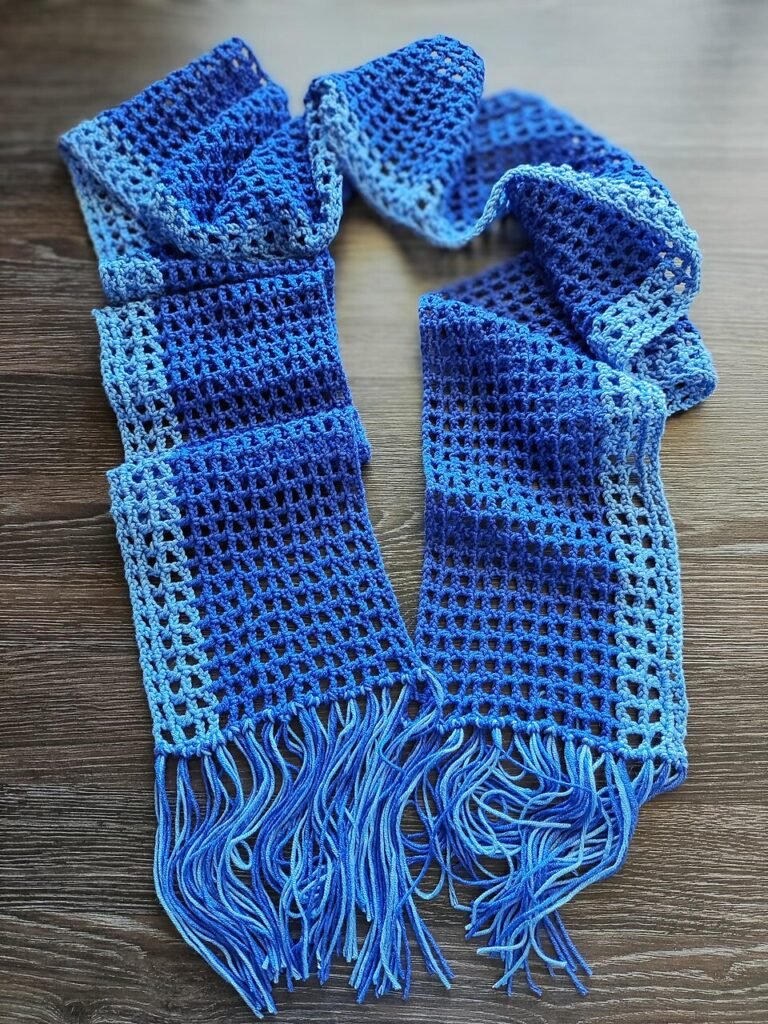
If you want a scarf finished in a weekend, this is the one. Chunky yarn and tall treble stitches build up length very quickly. It is worked widthwise in short rows, so you can stop at any length you like.
Materials and size
- Yarn: chunky weight, about 300g to 400g (roughly 400m to 550m). This is an estimate.
- Hook: 8mm.
- Finished size: about 20cm wide and 150cm long.
- Tension: roughly 10 tr and 5 rows to 10cm.
Pattern
Foundation: Ch 22.
Row 1: Tr in 4th ch from hook (the skipped 3 ch count as the first tr) and in each ch to the end. Turn. (20 sts)
Row 2: Ch 3 (counts as first tr), skip the first st, tr in each st to the end, working the last tr into the top of the turning chain. Turn. (20 sts)
Repeat Row 2 until the scarf is about 150cm long, roughly 70 to 80 rows. Fasten off and weave in the ends.
Tips for this pattern
- The most common mistake is missing the last stitch, the top of the turning chain. If your scarf gets narrower, that is usually why.
- If the edges look gappy, try ch 2 instead of ch 3 at the start of each row. It still counts as the first tr, so the count stays at 20.
- For a wider scarf, add chains in any number. You will have 2 fewer stitches than chains.
Comparing the three free crochet scarf patterns
| Pattern | Yarn | Hook | Approx. size | Feel |
|---|---|---|---|---|
| Ribbed htr (lengthwise) | Aran | 5.5mm | 150 x 18cm | Stretchy, ribbed |
| Moss stitch | DK | 5mm | 160 x 18cm | Flat, woven texture |
| Chunky treble | Chunky | 8mm | 150 x 20cm | Thick and quick |
For a first crochet scarf pattern, the chunky treble scarf is the fastest. The moss stitch scarf is the most relaxing once you know the rhythm, and the ribbed scarf gives the most professional look.
How to add a fringe to a crochet scarf pattern
A fringe is a simple way to finish any of these scarves. It also hides slightly uneven short edges.
- Decide how long you want the fringe, for example 10cm.
- Cut a piece of card a little taller than that length, about 11cm for a 10cm fringe. Wrap yarn around it and cut along one edge to make strands about 22cm long.
- Take 3 or 4 strands together and fold them in half.
- Push your hook through a stitch on the short edge of the scarf, from front to back.
- Catch the folded middle of the strands and pull it through to make a loop.
- Pull all the loose ends through the loop and tug gently to tighten.
- Repeat evenly across both short edges, then lay the scarf flat and trim the fringe level with sharp scissors.
On the lengthwise ribbed scarf, the short edges are the row ends. Place a fringe bundle in every other row end for an even look.
Making tassels instead
Tassels look lovely on the corners of a scarf. Wrap yarn about 20 times around a 10cm piece of card. Slide a strand under the wraps at the top and tie it tightly. Cut through the wraps at the bottom. Wrap another strand around the tassel about 1.5cm below the top, knot it and hide the ends inside. Trim the bottom level and sew the tassel to the scarf with the top ties.
Blocking your finished scarf
Blocking relaxes the stitches, straightens the edges and makes any crochet scarf pattern look more polished. It is worth doing even on a simple scarf.
Wet blocking for wool and wool blends
- Soak the scarf in cool water for about 15 minutes.
- Gently squeeze out the water. Do not wring or twist it.
- Roll it in a towel and press to remove more water.
- Lay it flat on a towel or blocking mats and ease it into shape. Pin the edges straight if needed.
- Leave it to dry completely before moving it.
Steam blocking for acrylic
Pin the scarf flat, then hold a steam iron a few centimetres above it and let the steam soak in. Never press the iron onto acrylic yarn, as heat can flatten it permanently. Leave it pinned until it is cool and dry.
Always check the yarn label first. Some yarns have specific care instructions.
Common problems and how to fix them
Most issues with a crochet scarf pattern come down to stitch counts or tension. Here are the usual culprits.
- The scarf is getting wider or narrower. Count stitches at the end of every few rows. Missing the last stitch or working twice into the first stitch is the usual cause.
- The foundation edge is tighter than the rest. Use a larger hook for the chain only, then switch back to the pattern hook.
- The edges are wavy. Blocking usually fixes this. Next time, keep the turning chain snug.
- The fabric is stiff. Try a hook one size larger. A scarf should drape, not stand up on its own.
Ways to style and gift a handmade scarf
Once you have made one crochet scarf pattern, it is easy to adapt it. Make a shorter scarf for a child by reducing the length, or join the two short ends to make a cowl. You can also make a matching hat; our crochet hat pattern pairs nicely with any of these scarves, and our crochet fingerless gloves complete the set.
A handmade scarf makes a thoughtful present. Fold it neatly, tie it with ribbon and add a small tag with the washing instructions from the yarn label.
Want something bigger to wear? Try our easy crochet shawl patterns, a granny triangle shawl and a moss stitch wrap in UK terms.
If you can crochet a scarf, you can make a cardigan: try our crochet cardigan pattern made from simple rectangles.
Frequently asked questions about crochet scarf pattern projects
How long should a crochet scarf be?
For most adults, 150cm to 180cm is a comfortable length that wraps once around the neck with ends hanging down. For a child, 100cm to 120cm usually works. Measure a scarf you already like if you are unsure.
How much yarn do I need for a crochet scarf?
It depends on the yarn weight, the stitch and the size. As a rough guide, an adult scarf takes about 200g to 300g of DK or aran, or 300g to 400g of chunky. Buy all your yarn at the same time so the colour matches.
What is the easiest crochet scarf pattern for a complete beginner?
The chunky treble scarf above is the quickest, and the ribbed half treble scarf is very simple once the foundation chain is done. Both repeat a single row all the way through.
Should I crochet a scarf lengthwise or widthwise?
Lengthwise means fewer, very long rows and a long foundation chain, and it creates stripes or ridges that run along the scarf. Widthwise means many short rows, and you can stop at any length. Both work well; it comes down to the look you prefer.
Why does my crochet scarf curl?
Curling is usually caused by tight tension, especially in the foundation chain. Use a larger hook for the chain, relax your grip, and block the finished scarf to help it lie flat.